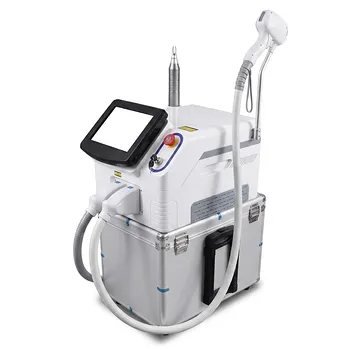
Differentiate the pattern, hormonal relationship, and cause before selecting a laser protocol. Hirsutism is androgen-dependent coarse terminal hair growth in women, typically in a male-pattern distribution such as the upper lip, chin, chest, abdomen, or back. Hypertrichosis is excess hair growth that is not restricted to an androgen-dependent pattern, may involve any sex or body site, and can affect fine, vellus, or terminal hair.
Laser treatment can reduce visible hair in both conditions, but it does not establish the diagnosis or correct an underlying cause. Suspected hirsutism—particularly when it is new, rapidly progressive, or accompanied by menstrual or virilization symptoms—should prompt medical evaluation alongside cosmetic treatment.
Start With the Clinical Pattern
Identify whether growth follows an androgen-dependent distribution
Hirsutism is defined by coarse terminal hair in areas normally influenced by androgens. Common sites include the face, neck, chest, lower abdomen, and back.
Hypertrichosis may occur on the arms, legs, shoulders, trunk, or other locations without following a male-pattern distribution. It may be localized or generalized.
Assess the patient’s sex and hormonal context
Hirsutism is a clinical diagnosis used primarily in women because it describes androgen-dependent hair growth in a female patient. Excess facial or body hair in men should not automatically be classified as hirsutism; the assessment should consider whether the growth is abnormal for the individual and whether other symptoms are present.
Hypertrichosis can affect males or females and does not require evidence of androgen excess or increased androgen sensitivity.
Examine the hair type
The key finding in hirsutism is coarse, pigmented terminal hair developing in an androgen-responsive area.
Hypertrichosis may involve:
- Lanugo hair
- Vellus hair
- Terminal hair
- A mixture of hair types, depending on the cause and location
Hair thickness, color, density, and the proportion of terminal hairs should be documented because these factors affect expected laser response.
Take a Focused History
Establish when the excess hair began
Ask whether the hair growth is:
- Congenital or present since childhood
- Associated with puberty
- Gradual and longstanding
- New or rapidly progressive
A sudden increase in coarse facial or body hair is more concerning for an acquired endocrine or medication-related cause than a stable lifelong pattern.
Review menstrual and hormonal symptoms
For female patients with suspected hirsutism, ask about:
- Irregular or absent menstrual periods
- Infertility
- Acne
- Scalp hair thinning
- Weight change
- Symptoms suggesting androgen excess
Polycystic ovary syndrome is a common association, but hirsutism can also occur with other ovarian, adrenal, medication-related, or idiopathic causes.
Screen for signs of virilization
Rapid progression, deepening of the voice, increased muscle mass, clitoral enlargement, or marked scalp hair loss requires medical assessment before treating the condition as a routine cosmetic concern.
These findings are not explained by ordinary unwanted hair alone and may indicate significant androgen excess or another underlying disorder.
Review medications and systemic conditions
Hypertrichosis may be associated with medications such as minoxidil, corticosteroids, or cyclosporine, as well as systemic or genetic conditions.
The practitioner should document medication timing, dosage changes, and the onset of hair growth. Patients should not be advised to discontinue prescribed medication without the involvement of the prescribing clinician.
Use Objective Documentation
Record the distribution and severity
Standardized photographs, body-site mapping, and consistent lighting help distinguish localized from generalized growth and allow reliable follow-up.
For female patients, a validated scoring method such as the modified Ferriman–Gallwey score may support assessment of androgen-dependent hair growth. It should be treated as a clinical aid rather than a substitute for history, examination, or medical evaluation.
Document hair and skin characteristics
Record:
- Hair color and diameter
- Terminal versus vellus hair
- Hair density
- Skin phototype
- Recent tanning or pigment changes
- Previous waxing, plucking, shaving, or laser treatment
- Presence of inflammation, folliculitis, scarring, or pigmentary changes
This information is relevant both to diagnosis and to safe device selection.
Recognize the limits of device-based assessment
Hair-analysis tools can help measure shaft thickness, density, and skin characteristics, but they cannot determine whether hair growth is caused by PCOS, medication, adrenal disease, or another systemic condition.
A laser platform is a treatment device, not an endocrine diagnostic instrument.
Connect the Diagnosis to Treatment Planning
Hirsutism requires expectation management
Laser or IPL treatment can produce substantial, long-term hair reduction in hirsutism, particularly when the target hairs are coarse and pigmented.
However, continued hormonal stimulation may activate additional follicles or promote regrowth. Patients should therefore understand that laser treatment may need to be combined with medical management and periodic maintenance.
Hypertrichosis requires cause-specific assessment
When hypertrichosis is congenital, stable, and localized, treatment may be planned primarily around hair and skin characteristics.
When it is acquired or generalized, the practitioner should consider medication exposure and systemic disease. Treating the hair without addressing a continuing trigger may lead to persistent or recurrent growth.
Match the device to the hair and skin
Professional diode, Alexandrite, and Nd:YAG systems use selective photothermolysis to target melanin in the hair follicle. The appropriate wavelength and settings depend on skin phototype, tanning status, hair color, hair diameter, anatomical site, and the specific device’s validated operating parameters.
Dark, coarse terminal hair generally provides a better optical target than fine, light, gray, or white hair. Device selection should follow manufacturer guidance, clinical training, and local safety requirements rather than diagnosis alone.
Know When to Refer Before Treatment
Refer patients with concerning onset or symptoms
Medical evaluation is appropriate when there is:
- Rapidly progressive hair growth
- Severe or sudden-onset hirsutism
- Menstrual irregularity or infertility
- Virilization
- Significant acne or scalp hair loss
- Generalized acquired hypertrichosis
- A possible medication-related cause
- Other unexplained systemic symptoms
The referral may involve primary care, dermatology, endocrinology, or gynecology depending on the presentation.
Avoid treating an unexplained change as purely cosmetic
A clinic can provide hair-reduction treatment while coordinating medical evaluation, but unexplained rapid progression should not be dismissed as ordinary unwanted hair.
The safest approach is to document the findings, explain why assessment is warranted, and avoid creating unrealistic expectations about the permanence of laser results.
Understanding the Trade-offs
Laser reduces hair but does not guarantee eradication
Professional light-based devices provide long-term hair reduction, not a guarantee that every follicle will be permanently eliminated.
Multiple treatment sessions are normally required because follicles respond most effectively during relevant growth phases. Maintenance treatments may also be needed.
Treating fine hair has limitations
Fine or lightly pigmented hair contains less melanin and may respond less predictably. Inappropriate treatment of very fine facial hair can also carry a risk of paradoxical hypertrichosis in susceptible patients, particularly in some facial treatment contexts.
This risk should be included in informed consent when clinically relevant.
Hormonal disease can limit durability
In hirsutism, laser treatment addresses the existing hair follicle but not the hormonal environment that may continue stimulating hair growth.
A good result therefore depends on both appropriate optical treatment and, when indicated, evaluation and management of the underlying endocrine driver.
Temporary methods are not equivalent to follicular treatment
Shaving and chemical depilation remove visible hair temporarily, while waxing and mechanical epilation remove the shaft and may temporarily remove the hair from the follicle.
These methods do not provide the same follicular targeting as laser treatment and may cause irritation, folliculitis, or pseudofolliculitis in some patients.
Making the Right Choice for Your Goal
Use the following framework during consultation and treatment planning:
- If your primary focus is diagnostic differentiation: Determine whether the hair is coarse and androgen-dependent in a female male-pattern distribution, or whether it is non-androgen-dependent hair occurring at any site or in any sex.
- If your primary focus is patient safety: Refer patients with rapid onset, virilization, menstrual abnormalities, generalized acquired growth, or possible systemic or medication-related causes.
- If your primary focus is treatment planning: Document hair color, diameter, density, distribution, skin phototype, and previous hair-removal methods before selecting a professional device and protocol.
- If your primary focus is long-term results: Explain that hirsutism may require concurrent medical management and that both conditions may require multiple sessions and maintenance.
- If your primary focus is informed consent: Describe laser therapy as long-term hair reduction rather than guaranteed permanent eradication, especially for hormonally driven or fine-hair conditions.
A reliable assessment separates the visible hair pattern from the underlying cause, allowing the practitioner to treat appropriately while recognizing when medical evaluation is essential.
Summary Table:
| Parameter | Hirsutism | Hypertrichosis |
|---|---|---|
| Definition | Androgen-dependent coarse terminal hair in women, male-pattern distribution | Excess hair not limited to androgen-dependent areas, any sex or site |
| Distribution | Upper lip, chin, chest, abdomen, back | Arms, legs, shoulders, trunk, localized or generalized |
| Hormonal relationship | Usually androgen-dependent; may indicate endocrine disorder | Not necessarily androgen-related; often idiopathic or due to medications/systemic conditions |
| Onset | Often at puberty or later; may be rapid if pathological | Can be congenital or acquired; gradual or sudden |
| Hair type | Coarse, pigmented terminal hair | Vellus, lanugo, or terminal hair; may be mixed |
| Sex | Primarily women | Both men and women |
| Treatment approach | Laser/IPL for hair reduction; may need medical management of underlying cause | Laser/IPL based on hair/skin characteristics; address underlying cause if acquired |
| Prognosis | Results may be less durable if hormonal stimulation persists | Depends on cause; stable cases may have good results |
Enhance your clinic's hair removal success with BELIS's advanced diode lasers, designed for accurate and safe treatment of hirsutism and hypertrichosis. Contact our specialists today for expert guidance and premium equipment tailored to your needs.
Related Products
- Clinic Diode Laser Hair Removal Machine with SHR and Trilaser Technology
- 808nm Diode Laser Hair Removal Machine 755+808+1064nm Mixed Wavelength Professional Equipment
- Diode Tri Laser Hair Removal Machine for Clinic Use
- 808nm Diode Laser Hair Removal Machine and Equipment with Picolaser Arm
- Diode Laser SHR Trilaser Hair Removal Machine for Clinic Use
People Also Ask
- How can aesthetic practitioners prevent side effects like paradoxical hair regrowth and thermal burns when performing diode laser hair removal on dark skin? Master safe protocols for Fitzpatrick IV–VI skin.
- How do broad-spectrum noncoherent light sources compare to single-wavelength diode lasers in aesthetic hair removal applications? Find the best fit for your clinic.
- What are the advantages of the Constant Motion Technique? Elevate Your Clinic's Laser Hair Removal Results
- Why can traditional high-energy pulse (HR) modes lead to adverse skin reactions? Understanding Thermal Injury Risks
- Why is a 40-ms pulse width critical for Fitzpatrick skin types III-V? The Key to Safe & Effective Laser Hair Removal