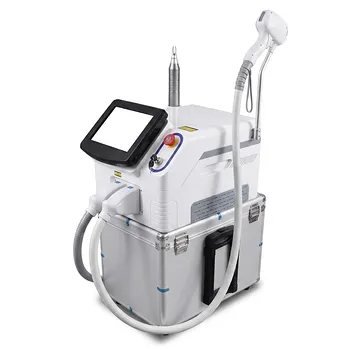
The combination works by targeting two major drivers of inflammatory acne at different depths. The 1450 nm diode laser delivers dermal heat to hyperactive sebaceous glands, reducing their activity and sebum output, while the 595 nm pulsed-dye laser (PDL) is preferentially absorbed by blood vessels and helps reduce vascular inflammation and redness. Used together, these mechanisms can produce substantial inflammatory lesion reduction, with reports of up to an 84% reduction after three sessions.
Core takeaway: The 1450 nm laser primarily addresses the sebaceous-gland and sebum component of acne, while the 595 nm PDL primarily addresses vascular inflammation and erythema. Their complementary action can improve active inflammatory acne and associated redness more comprehensively than targeting either pathway alone.
How the Two Wavelengths Address Acne
The 1450 nm diode laser targets sebaceous glands
The 1450 nm wavelength penetrates into the mid-dermis, where the pilosebaceous units and sebaceous glands are located. Its energy is absorbed predominantly by tissue water, producing controlled photothermal heating.
This heat can thermally injure and reduce the volume or activity of hyperactive sebaceous glands. The resulting reduction in sebum may lessen follicular occlusion and create a less favorable environment for acne-associated inflammation.
The 595 nm PDL targets vascular inflammation
The 595 nm PDL is preferentially absorbed by oxyhemoglobin in small dermal blood vessels. This allows it to target the vascular component of inflammatory papules and pustules.
By reducing vascular inflammation, the PDL can decrease the redness associated with active acne and help resolve the erythematous appearance of lesions more rapidly.
The PDL may also affect acne-associated bacteria
Acne-associated Cutibacterium acnes—formerly called Propionibacterium acnes—produces endogenous porphyrins that can interact with visible light. This provides a potential additional photochemical route for reducing bacterial activity and inflammatory signaling.
However, the most established role of the 595 nm PDL is vascular targeting. Bacterial reduction should be viewed as a contributing mechanism rather than the sole or definitive explanation for its clinical effect.
Why Combining the Lasers Can Be Beneficial
The treatment covers different acne drivers
Acne is not caused by a single process. Sebum overproduction, follicular plugging, microbial activity, and inflammation interact within the pilosebaceous unit.
The 1450 nm laser primarily addresses the sebaceous and thermal component, while the PDL addresses the vascular and inflammatory component. This division of labor explains why the combination may provide broader clinical improvement than either wavelength used alone.
Lesion clearance and redness can improve together
A treatment that only reduces sebum may not fully address persistent inflammatory redness. Conversely, a vascular laser may reduce erythema without sufficiently changing the underlying sebaceous activity.
Combining the modalities can therefore improve both active inflammatory lesion counts and the visible red component of acne, producing a more complete cosmetic and clinical response.
The combination may benefit difficult or refractory acne
This approach can be considered when inflammatory acne persists despite topical treatment or when a non-ablative, device-based option is clinically appropriate. It may be particularly useful when both active lesions and prominent erythema are present.
The reported outcome of up to 84% lesion-count reduction after three treatment sessions indicates strong potential, but results depend on the treatment protocol, acne severity, patient characteristics, and study design.
What the Clinical Benefit Typically Involves
Reduction in sebum-related activity
Thermal modification of the sebaceous glands may reduce sebum output and gland volume. Supplementary clinical data describe lesion reductions of approximately 50% to 83% with multi-session 1450 nm protocols, although individual outcomes vary.
The effect is not equivalent to permanently eliminating all sebaceous glands. Recurrence or partial return of activity remains possible.
Reduction in inflammatory lesions
By combining gland-directed heating with vascular anti-inflammatory treatment, the system can reduce the number and persistence of papules and pustules. Lesions may also resolve more quickly as inflammatory vascular activity decreases.
The strongest rationale applies to inflammatory acne, rather than comedonal acne alone.
Improvement in acne-associated erythema
The 595 nm PDL can reduce the vascular redness that makes active acne appear more pronounced. This may improve the overall appearance even when residual lesions or post-inflammatory changes remain.
It is important to distinguish active inflammatory redness from established post-inflammatory hyperpigmentation, which is a pigmentary rather than primarily vascular target.
How the Treatment Is Delivered
The 1450 nm treatment requires epidermal protection
Because the 1450 nm laser produces meaningful dermal heating, systems commonly use dynamic surface cooling to protect the epidermis. Reported protocols include a 6 mm spot size, fluences in the range of 12–18 J/cm², and cooling durations of approximately 30–40 milliseconds.
Actual settings must be individualized according to skin type, treatment area, acne severity, device design, and the patient’s response.
Multiple sessions are usually needed
Acne improvement generally develops over a series of treatments rather than from a single exposure. Sessions are commonly spaced several weeks apart to allow inflammation and thermal effects to settle.
The reported three-session result should not be interpreted as a guaranteed outcome or as evidence that every patient will achieve the same degree of clearance.
Photosensitizers are not automatically part of the protocol
Topical aminolevulinic acid (ALA) can increase porphyrin-mediated photodynamic activity when activated by suitable light sources, including PDL. This is a distinct photodynamic therapy approach and should not be assumed to be included in every 595 nm PDL treatment.
If ALA is used, the protocol, incubation period, photosensitivity precautions, and adverse-effect profile change substantially.
Understanding the Trade-offs
Thermal discomfort can be significant
The 1450 nm laser produces substantial heat in the dermis. Topical anesthesia may be considered, particularly for higher-energy protocols or sensitive treatment areas.
Cooling improves epidermal safety but does not eliminate treatment discomfort.
Temporary adverse effects are expected
Common short-term reactions include mild erythema, localized edema, and tenderness. Temporary pigmentary changes, including hyperpigmentation, can occasionally occur.
Risk management is especially important for patients with darker Fitzpatrick skin phototypes, despite the potential for the technology to be used in these populations with appropriate settings and expertise.
Results are not necessarily permanent
The treatment can reduce sebaceous activity, but it does not permanently remove every acne predisposition. Hormonal influences, skincare products, medication changes, and other acne triggers may continue to affect disease activity.
Maintenance treatment or conventional topical therapy may still be appropriate.
Evidence should be interpreted carefully
An 84% lesion-count reduction is a reported upper-end outcome, not a universal expectation. Comparisons between combination treatment and single-wavelength therapy require properly controlled clinical studies using comparable treatment settings and follow-up periods.
The combination should therefore be presented as a potentially comprehensive adjunct or alternative treatment—not as a guaranteed cure or replacement for all medical acne therapies.
Making the Right Choice for Your Goal
The appropriate role of combined 1450 nm and 595 nm treatment depends on the patient’s dominant acne features and clinical risk profile.
- If your primary focus is reducing sebum and recurrent inflammatory lesions: Prioritize the 1450 nm diode component, using controlled dermal heating and appropriate epidermal cooling.
- If your primary focus is reducing redness and vascular inflammation: Prioritize the 595 nm PDL component, which targets oxyhemoglobin-rich superficial vessels.
- If your primary focus is treating both active lesions and prominent erythema: Consider the combined approach because it addresses sebaceous activity and vascular inflammation in the same treatment plan.
- If your primary focus is treating resistant or severe acne: Use the devices as part of a broader, individualized acne-management strategy rather than relying on laser treatment alone.
When appropriately selected and delivered, the combination offers a rational dual-target strategy for reducing both the biological activity and visible inflammatory burden of active acne vulgaris.
Summary Table:
| Wavelength | Primary Target | Mechanism | Clinical Benefit |
|---|---|---|---|
| 1450 nm diode laser | Sebaceous glands | Photothermal heating reduces sebaceous gland activity | Reduces sebum production and follicular occlusion |
| 595 nm pulsed-dye laser | Blood vessels | Absorbed by oxyhemoglobin, reduces vascular inflammation | Decreases erythema and accelerates lesion resolution |
| Combined | Both sebaceous and vascular components | Complementary action addresses multiple acne drivers | Up to 84% reduction in inflammatory lesions after three sessions |
Ready to enhance your clinic's acne treatment offerings? BELIS offers advanced 1450 nm diode and 595 nm PDL systems, designed for professional use in clinics and premium salons. Our devices combine efficacy, safety, and reliability, supporting you in delivering exceptional results. Contact us today at [#ContactForm] to learn more about our aesthetic equipment and how we can help you achieve superior patient outcomes.
Related Products
- Diode Laser SHR Trilaser Hair Removal Machine for Clinic Use
- Clinic Diode Laser Hair Removal Machine with SHR and Trilaser Technology
- Tri Laser Diode Hair Removal Machine Professional Beauty Equipment
- Diode Tri Laser Hair Removal Machine for Clinic Use
- Trilaser Diode Hair Removal Machine for Beauty Clinic Use
People Also Ask
- What is the working mechanism of professional-grade Diode laser equipment? Master the Physics of Selective Photothermolysis
- What are the characteristics of the Diode laser for hair removal? The Gold Standard for Deep Efficacy and Skin Safety
- What are the technical advantages of using industrial-grade Diode lasers? Superior Precision for Professional Clinics
- What advancements have occurred in laser hair removal machine technology? Trends Shaping Modern Aesthetic Clinics
- How long does a single laser hair removal session take? Fast & Effective Treatments for Your Busy Schedule