
Following an SHR treatment, your hair does not fall out immediately. Instead, the treated hair remains in the follicle for a period of time before the body begins to push it out. This shedding process occurs gradually over several days to weeks and can often be mistaken for new hair growth.
SHR is not an instant removal method but a gradual reduction process. The visible shedding is a sign the treatment is working by targeting hair follicles in their active growth phase, which is why multiple sessions are essential for a successful outcome.
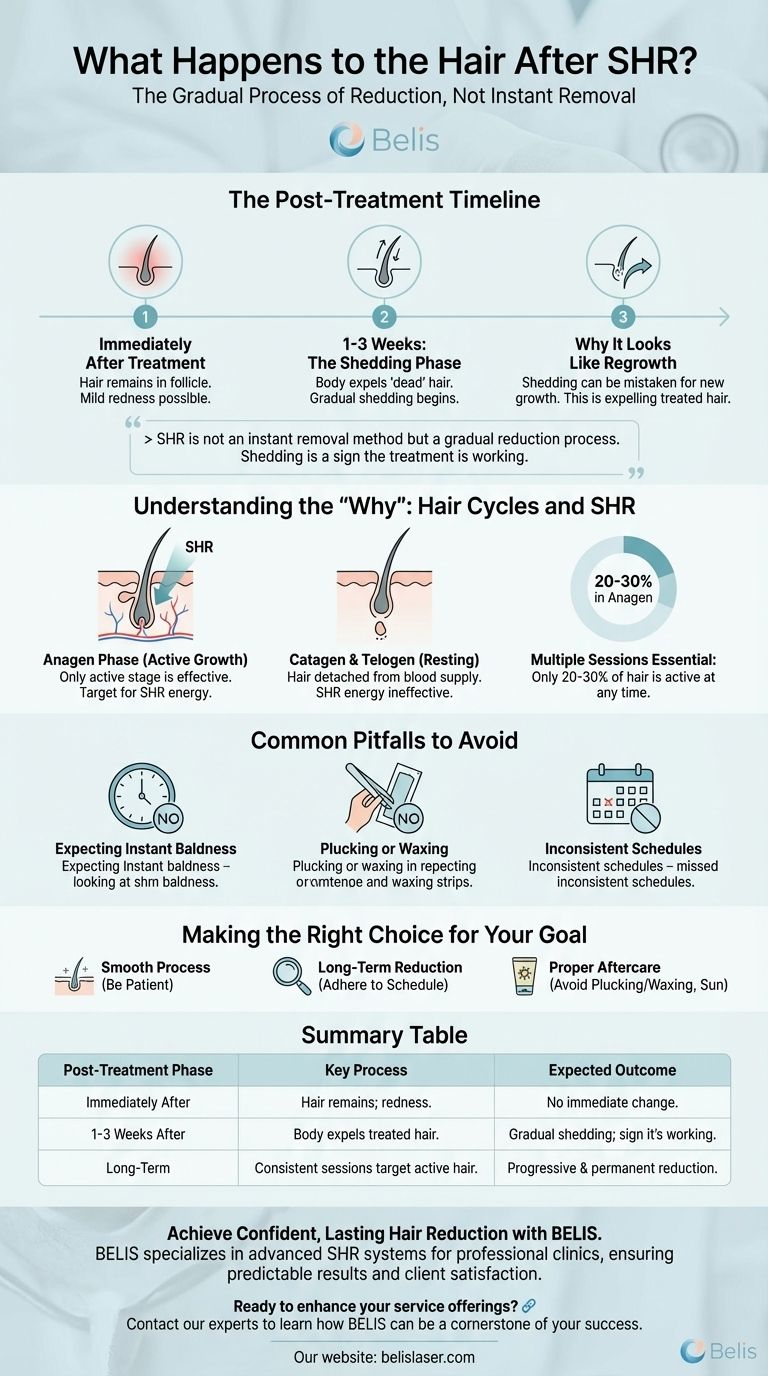
The Post-Treatment Timeline: What to Expect
To understand the results, it's crucial to know what happens in the days and weeks following a session. The process is biological, not mechanical.
Immediately After Treatment
Right after your appointment, the treated hair will look completely unchanged. You may experience some mild redness or a sensation similar to a light sunburn, but the hair itself will still be present in the follicles.
The First 1-3 Weeks: The Shedding Phase
This is the period where you will see the results. The energy from the SHR treatment has damaged the hair follicle, essentially disabling its ability to grow new hair.
The body then begins to expel the "dead" hair shaft that was in the follicle. This hair is slowly pushed to the surface and will fall out on its own.
Why It Can Look Like Regrowth
As the hair is pushed out of the follicle, it can appear to be growing. This is the most common point of confusion.
It is critical to understand that this is not new growth. It is the final expulsion of the treated hair before the follicle enters a dormant state.
Understanding the "Why": Hair Cycles and SHR
The reason for this gradual process—and the need for multiple treatments—is rooted in the natural growth cycle of your hair. SHR is only effective during one specific phase.
The Anagen Phase (Active Growth)
This is the only stage where the hair is actively growing and is directly attached to its blood supply (the papilla). The pigment in the hair acts as a conduit for the SHR energy to travel down and destroy the follicle's growth center.
The Catagen and Telogen Phases (Resting)
In these transitional and resting phases, the hair has detached from its blood supply.
Because there is no longer a direct connection, the SHR energy cannot effectively reach and disable the follicle. Hairs in this stage will not be affected by the treatment.
The Necessity of Multiple Sessions
At any given time, only a certain percentage of your hair (typically 20-30%) is in the active Anagen phase.
Multiple, spaced-out treatments are required to catch all of your hair as it naturally cycles into the effective Anagen phase.
Common Pitfalls to Avoid
Managing expectations and following proper protocol between sessions is essential for success.
Expecting Instant Baldness
The most significant error is expecting smooth, hair-free skin immediately after one session. SHR is a process of gradual hair reduction, not instantaneous removal.
Plucking or Waxing Between Sessions
You must not pluck or wax the hair in the treatment area. Doing so removes the hair shaft from the follicle.
Without the hair to act as a bridge, the energy from the next SHR session has no path to reach and destroy the follicle. Shaving is perfectly acceptable as it leaves the root intact.
Inconsistent Treatment Schedules
Skipping appointments or extending the time between them can compromise your results. The schedule is designed to target hair as it enters the Anagen growth phase. A consistent schedule ensures maximum effectiveness.
Making the Right Choice for Your Goal
Understanding the process allows you to align your expectations with the treatment's reality.
- If your primary focus is a smooth, effective process: Be patient and view the shedding phase as a positive sign that the treatment is working as intended.
- If your primary focus is achieving the best long-term reduction: Adhere strictly to your technician's recommended treatment schedule to target hairs in every growth cycle.
- If your primary focus is proper aftercare: Avoid plucking, waxing, and significant sun exposure on the treated area, but feel free to shave as needed.
Understanding this natural shedding cycle is the key to managing expectations and achieving the lasting results you seek.
Summary Table:
| Post-Treatment Phase | Key Process | Expected Outcome |
|---|---|---|
| Immediately After | Hair remains in follicle; mild redness possible. | No immediate change in hair appearance. |
| 1-3 Weeks After | Body expels the treated hair shaft from the disabled follicle. | Gradual shedding begins; this is a sign the treatment is working. |
| Long-Term | Consistent sessions target new hair in the active growth phase. | Progressive and permanent hair reduction over time. |
Achieve Confident, Lasting Hair Reduction with BELIS
Understanding the SHR process is the first step toward smooth, hair-free skin. For medical aesthetics clinics and premium beauty salons, delivering predictable, satisfying results to your clients is paramount.
BELIS specializes in professional medical aesthetic equipment, including advanced SHR systems designed for safety, efficacy, and superior patient comfort. Our technology helps you build trust and ensure client retention by delivering on the promise of gradual, permanent hair reduction.
Ready to enhance your service offerings with reliable technology?
Contact our experts today to learn how BELIS equipment can become a cornerstone of your practice's success.
Visual Guide
Related Products
- IPL SHR Hair Removal Machine for Permanent Hair Removal
- Diode Laser SHR Trilaser Hair Removal Machine for Clinic Use
- Clinic Diode Laser Hair Removal Machine with SHR and Trilaser Technology
- Clinic Use IPL and SHR Hair Removal Machine with Nd Yag Laser Tattoo Removal
- Clinic Use IPL SHR ND YAG Laser Hair Removal RF Skin Tightening Machine
People Also Ask
- Does IPL work on all hair types? The Truth About Melanin & Hair Removal Success
- Can you overdo at home laser hair removal? Avoid Burns and Pigmentation Risks
- Do you have to shave before using hair removal device? The Critical Step for Safe & Effective Results
- What are the economic and clinical benefits of using exogenous dyeing for IPL hair removal? Maximize ROI & Versatility
- Does IPL hair removal actually work? Achieve Long-Term Hair Reduction










