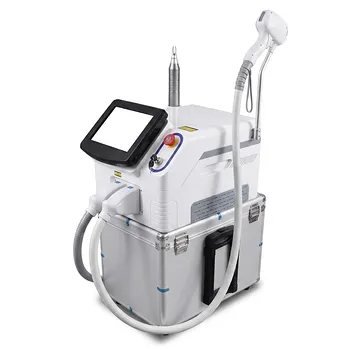
Index-guided diode lasers confine light and carriers with the semiconductor structure, while gain-guided lasers confine them primarily through the electrical excitation pattern. In a laser treatment handpiece, this structural distinction directly affects beam quality: index-guided devices generally produce a more stable, lower-astigmatism beam with a near-elliptical Gaussian profile, whereas gain-guided devices tend to produce more complex intensity patterns and greater optical divergence. As a result, index-guided emitters are usually easier to focus into a delivery fiber or distribute uniformly across a treatment spot.
The key difference is the source of confinement: index-guided lasers use a two-dimensional refractive-index profile, while gain-guided lasers use a shaped contact and carrier-density profile. Index guidance generally provides better control of beam shape and energy distribution, which is particularly important when a handpiece must deliver therapeutic energy without inefficient coupling or localized hot spots.
How the Two Laser Structures Confine Light
Index-guided laser structure
An index-guided diode laser uses semiconductor layers and lateral waveguide features to create a two-dimensional refractive-index profile. Light is confined where the refractive index is higher, while the active region also confines the injected charge carriers.
This waveguide acts like a defined optical channel. The laser mode is therefore determined substantially by the physical geometry and refractive-index contrast of the device, rather than only by where current happens to flow.
Gain-guided laser structure
A gain-guided diode laser has less lateral refractive-index confinement. Instead, a shaped electrical contact strip controls where carriers are injected and where optical gain is highest.
The resulting optical mode follows the lateral gain distribution. Because carrier density, temperature, current spreading, and optical intensity can vary across the active region, the emitted field is generally less tightly controlled.
The practical structural distinction
Index-guided devices use material geometry to define the mode. Gain-guided devices use localized electrical gain to favor the mode.
This is analogous to the difference between light traveling through a shaped optical channel and light being encouraged to remain in a region by selectively amplifying it. The first approach normally provides more predictable spatial behavior.
How Structure Changes the Optical Output
Beam profile
Index-guided lasers generally produce a more regular, approximately elliptical Gaussian beam profile. The intensity changes smoothly across the beam, which supports predictable focusing and more uniform energy delivery.
Gain-guided lasers can produce a complex or nonuniform intensity distribution. The beam may contain irregular spatial structure, making the delivered energy less uniform unless the handpiece includes optical correction or beam homogenization.
Astigmatism
Astigmatism occurs when the beam has different apparent focal positions or focusing behavior in perpendicular axes. It is common in semiconductor lasers because the vertical and lateral dimensions of the emitting region differ.
Index-guided designs generally reduce this problem by providing stronger control over both transverse dimensions. Gain-guided devices typically exhibit higher astigmatism because their lateral mode is governed less precisely by a physical waveguide.
Beam quality and focusability
Beam quality determines how efficiently emitted power can be focused into a small target or coupled into an optical fiber. A stable, well-defined mode allows the handpiece optics to form a more predictable focal spot.
Index-guided emitters therefore offer a significant advantage where the treatment system requires efficient fiber coupling, a controlled focal spot, or uniform scanning over tissue. Gain-guided emitters may require additional optics to compensate for their less regular output.
Coherence and longitudinal mode behavior
The primary reference associates index-guided devices with stable single-longitudinal-mode emission and gain-guided devices with a shorter coherence length. The general engineering principle is sound, but the exact result depends on the device design.
Index guidance alone does not guarantee single-longitudinal-mode operation. Cavity length, reflector design, wavelength-selective structures, operating current, temperature, and feedback conditions also determine the longitudinal modes. In practice, a suitably designed index-guided laser can offer highly stable spectral and spatial output, while gain-guided sources commonly have broader or less stable optical behavior.
Threshold current
Index-guided lasers typically require a lower threshold current because their waveguide confines carriers and photons more effectively. More of the injected electrical energy contributes to the desired lasing mode.
Gain-guided devices can require more current to reach lasing because carrier and photon confinement is less precise. The exact threshold depends on the active material, cavity, aperture, temperature, and drive conditions.
Why These Differences Matter in Treatment Handpieces
Coupling energy into optical fibers
A handpiece that uses a delivery fiber benefits from a beam that is spatially stable and easy to focus. A more regular index-guided beam can improve coupling efficiency and reduce sensitivity to small alignment or focus changes.
A gain-guided beam may couple less efficiently because its intensity profile and astigmatism make it harder to match to the fiber mode. Corrective lenses, beam-shaping optics, or multimode coupling can reduce this limitation.
Maintaining a uniform treatment spot
For skin treatments, the clinically relevant question is not only how much power the diode emits, but how that power is distributed across the target area. A nonuniform beam can create regions receiving substantially more energy than adjacent regions.
Index-guided sources, or diode arrays combined with optical homogenization, are better suited to producing a controlled and repeatable treatment distribution. This helps reduce the risk of localized hot spots caused by spatial intensity peaks.
Focusing energy efficiently
A high-quality beam can be focused more efficiently because its wavefront and spatial mode are more predictable. This matters when the handpiece must place energy into a defined spot, fiber core, or treatment plane.
A gain-guided source may still be appropriate, but the optical design must account for its larger astigmatism and more complicated intensity distribution. The handpiece often carries more of the burden of correcting the source beam.
Using diode arrays
A handpiece may use multiple emitters rather than a single diode. In that situation, the individual beam quality and the array's optical layout both affect the final spot.
Index-guided emitters can simplify control of each beam, but an array can still produce nonuniform output if the emitters are misaligned or their beams are not homogenized. Optical correction and careful thermal and mechanical design remain important.
Understanding the Trade-offs
Better beam quality does not automatically mean better treatment
Index-guided sources generally offer superior beam control, but treatment performance depends on the entire optical path. Collimating lenses, focusing optics, fiber geometry, diffuser or homogenizer design, working distance, and tissue interaction all affect the final energy distribution.
A well-designed gain-guided system can therefore outperform a poorly designed index-guided system at the treatment surface.
Index guidance does not guarantee a single mode
A common oversimplification is to treat every index-guided diode as single longitudinal mode. Index guidance primarily improves spatial confinement; single-longitudinal-mode operation requires additional control of the laser cavity and spectrum.
The correct comparison is that index-guided architecture is more favorable for stable, well-controlled emission, not that it alone determines every spectral property.
Gain-guided output can be optically corrected
Gain-guided devices are not inherently unsuitable for medical handpieces. Cylindrical optics can address axis-dependent divergence, while diffusers, lens arrays, and other homogenizing elements can smooth the treatment profile.
The trade-off is increased optical complexity, potential coupling loss, and tighter requirements for alignment and calibration.
Thermal behavior can alter the beam
Both diode types are sensitive to temperature and drive conditions. Thermal changes can modify wavelength, divergence, output power, and the spatial distribution of energy.
A handpiece should therefore be evaluated at its actual operating temperature and duty cycle, rather than only from nominal diode specifications.
Making the Right Choice for Your Goal
The appropriate source depends on whether the handpiece prioritizes coupling, focusing, uniformity, or optical simplicity.
- If your primary focus is efficient fiber coupling: Prefer an index-guided or optically corrected source with a stable, well-controlled spatial mode.
- If your primary focus is a uniform skin-treatment spot: Use a source and beam-delivery system designed to homogenize intensity and prevent localized hot spots.
- If your primary focus is compact or economical implementation: A gain-guided source may be viable, provided the handpiece optics compensate for its astigmatism and nonuniform beam profile.
- If your primary focus is spectral or longitudinal-mode stability: Verify the complete diode cavity and operating specifications rather than assuming that index guidance alone guarantees single-mode emission.
For treatment handpieces, the best choice is the laser architecture that delivers the required energy distribution reliably at the tissue surface, not merely the one with the most favorable bare-diode specification.
Summary Table:
| Aspect | Index-Guided | Gain-Guided |
|---|---|---|
| Structural confinement | Refractive-index profile (waveguide) | Electrical excitation pattern (carrier injection) |
| Beam profile | Near-elliptical Gaussian, smooth | Complex, non-uniform intensity |
| Astigmatism | Low | High |
| Beam focusability | High, efficient fiber coupling | Lower, may require correction |
| Threshold current | Lower | Higher |
| Longitudinal mode stability | Can be stable, but depends on cavity design | Generally broader or less stable |
| Suitability for handpieces | Better for uniform energy delivery | Requires optical correction or homogenization |
Are you ready to enhance your aesthetic treatments with precision laser technology? At BELIS, we specialize in professional-grade medical aesthetic equipment for clinics and premium salons. Our advanced laser systems include diode, Alexandrite, CO2 fractional, Erbium, Nd:YAG, and Pico lasers, designed for optimal beam quality and treatment efficacy. Whether you need reliable fiber coupling or uniform spot delivery, our solutions are engineered to meet your exact requirements. Experience the BELIS difference and elevate your practice today — contact us now to discuss your needs and discover how our technology can benefit your patients and your business.
Related Products
- Diode Laser SHR Trilaser Hair Removal Machine for Clinic Use
- Tri Laser Diode Hair Removal Machine Professional Beauty Equipment
- Clinic Diode Laser Hair Removal Machine with SHR and Trilaser Technology
- 808nm Diode Laser Hair Removal Machine 755+808+1064nm Mixed Wavelength Professional Equipment
- Trilaser Diode Hair Removal Machine for Beauty Clinic Use
People Also Ask
- What is the working mechanism of professional-grade Diode laser equipment? Master the Physics of Selective Photothermolysis
- What are the characteristics of the Diode laser for hair removal? The Gold Standard for Deep Efficacy and Skin Safety
- What are the technical advantages of using industrial-grade Diode lasers? Superior Precision for Professional Clinics
- What advancements have occurred in laser hair removal machine technology? Trends Shaping Modern Aesthetic Clinics
- How long does a single laser hair removal session take? Fast & Effective Treatments for Your Busy Schedule