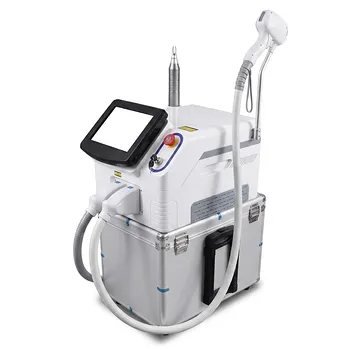
For deep facial telangiectasias and leg veins, a 1064 nm Nd:YAG laser should be used with vessel-specific fluence, active epidermal cooling, test spots, and strict control of pulse placement. Facial vessels commonly require approximately 50–120 J/cm² with 2.5–5 mm spot sizes, while leg veins commonly require 60–140 J/cm² with a spot size near 5 mm. These are reference ranges rather than universal prescriptions; the device’s validated treatment protocol, vessel diameter, skin phototype, pulse duration, and clinical endpoint must determine the final settings.
The central safety principle is to use the lowest effective fluence that produces intravascular coagulation or vessel collapse while preserving the epidermis. Cooling, conservative adjustments for darker or tanned skin, pretreatment testing, and avoidance of pulse stacking or spot overlap are essential.
Why 1064 nm Nd:YAG Is Used for Deeper Vessels
Deep tissue penetration
The 1064 nm wavelength penetrates more than 3 mm into the skin, allowing it to reach deeper and larger-caliber vessels than many shorter-wavelength systems.
This makes it particularly useful for leg veins, ankle telangiectasias, nasal telangiectasias, and other sub-epidermal vascular structures.
Lower melanin competition
Melanin absorbs 1064 nm energy relatively weakly compared with shorter wavelengths. This provides a wider treatment window, but it does not eliminate epidermal injury risk, especially when high fluences are used.
Patients with darker or recently tanned skin still require conservative parameters, careful cooling, and a test spot.
Photothermal vascular injury
The laser delivers millisecond-domain energy that is absorbed by hemoglobin and converted into heat. The intended effect is thermal injury to the vessel wall, followed by coagulation, thrombosis, collapse, and eventual clearance.
Key Treatment Parameters
Facial telangiectasias
Reference facial settings include:
- Fluence: approximately 50–120 J/cm², with many long-pulsed protocols concentrated around 75–100 J/cm²
- Spot size: generally 2.5–5 mm, commonly 5 mm for deeper vessels
- Pulse structure: some protocols use a double-pulse sequence of approximately 5–14 ms per pulse
- Inter-pulse interval: approximately 20 ms in double-pulse protocols
- Cooling: continuous external or integrated epidermal cooling
Facial skin generally requires more conservative treatment than the legs. Some guidance recommends reducing facial fluence by approximately 30–40% relative to leg-vein settings, although the actual adjustment must account for vessel size, depth, skin type, and the specific laser system.
Leg veins
Reference settings include:
- Fluence: approximately 60–140 J/cm²
- Spot size: approximately 5 mm
- Pulse duration: adjusted according to vessel diameter, depth, and the device’s validated protocol
- Cooling: active epidermal cooling throughout treatment
Larger or deeper leg veins may require higher fluence than facial telangiectasias, but increasing energy should not be the default response to poor clearance. Vessel characteristics, pulse duration, contact, and treatment selection should be reassessed first.
Pulse repetition and spacing
When treating deeper vessels, pulse repetition rates should generally remain at or below 1 Hz where required by the treatment protocol. Individual spots should be separated by at least 1 mm when specified by the system or clinical protocol.
Stacked pulsing should be avoided. Repeated pulses over the same location can create excessive heat accumulation, increasing the risk of epidermal injury, blistering, ulceration, and dermal breakdown.
Application Technique
Use a controlled vessel-following pattern
Deliver pulses linearly along the visible vessel rather than randomly treating the surrounding skin. The treatment pattern should follow the vessel from larger feeding structures toward smaller branches when clinically appropriate.
This approach helps distribute thermal energy along the vascular pathway and reduces unnecessary exposure of uninvolved skin.
Prevent overlap
Adjacent spots should not overlap. Overlap can act like unintended stacking by increasing local thermal load, even when each individual pulse is within the nominal fluence range.
Maintain consistent spacing and use the handpiece’s contact or aiming system to control placement.
Select the endpoint, not the maximum energy
The desired endpoint is usually intravascular coagulation, vessel collapse, or a linear hematoma corresponding to the treated vessel.
Immediate, marked whitening or bleaching of the surrounding skin suggests excessive fluence or excessive epidermal heating. Treatment should be stopped or parameters reassessed because this endpoint is associated with increased scarring risk.
Clinical Safety Protocols
Perform patient and lesion assessment
Before treatment, document:
- Vessel location, color, caliber, and estimated depth
- Skin phototype and recent tanning or ultraviolet exposure
- Previous vascular treatments and their outcomes
- Active infection, inflammation, dermatitis, or impaired healing
- Medications or conditions that may affect bleeding, photosensitivity, or wound healing
Leg-vein treatment also requires appropriate clinical assessment of whether the visible vessel is suitable for laser treatment. Larger or clinically significant venous disease may require vascular evaluation or another treatment modality.
Use a pretreatment test spot
A test spot is especially important when using high fluences, treating darker or tanned skin, or working with an unfamiliar device or lesion type.
Evaluate the immediate response and, where appropriate, delayed skin reaction before treating the full area. The test should identify the minimum effective dose that produces the intended vascular endpoint without excessive epidermal reaction.
Protect the epidermis continuously
Active cooling is a core safety requirement at these fluences. Depending on the system, this may include contact cooling, chilled coupling methods, cryogen spray, or continuous external cooling.
Cooling improves comfort and reduces epidermal temperature, but it does not compensate for excessive fluence, pulse stacking, poor spacing, or inadequate patient selection.
Protect the eyes
Appropriate wavelength-specific ocular protection is required for the patient, operator, and everyone within the controlled treatment area. Facial treatment requires particular attention to eye protection and positioning because the treatment field is close to the orbit.
Protective measures must comply with the laser manufacturer’s instructions and applicable clinical laser-safety standards.
Control pain and movement
High-fluence 1064 nm treatment can be painful, particularly on the legs. Use the device’s validated cooling and pain-control protocol; topical or other anesthesia may be considered when clinically appropriate.
Pain that is disproportionate to the expected response can indicate excessive heating, inadequate cooling, or an incorrect treatment location and should prompt immediate reassessment.
Follow the device-specific instructions for use
Fluence, pulse duration, pulse sequencing, repetition rate, cooling method, and permissible spot overlap vary by device. Published ranges should therefore be treated as clinical reference points, not as a substitute for the manufacturer’s instructions, training, or local medical governance.
Understanding the Trade-offs
Higher fluence can improve vessel coagulation
Deep or larger vessels often require substantial fluence because the target is farther from the epidermis and contains more blood volume.
However, higher fluence also increases the risk of excessive dermal heating, purpura, blistering, pigmentary change, scarring, and delayed healing.
Deep penetration does not guarantee safe treatment
The relatively low melanin absorption of 1064 nm improves the safety margin compared with some shorter wavelengths, but the laser still deposits significant heat in tissue.
Skin type, tanning, cooling quality, vessel depth, pulse duration, and spot placement all influence risk.
Laser is not appropriate for every leg vein
Superficial spider veins, larger reticular veins, and underlying venous insufficiency may respond differently. Some lesions may be better managed with sclerotherapy, vascular assessment, or a combined approach.
Laser treatment should not be selected solely because a vessel is visible.
Immediate appearance can be misleading
A vessel may appear improved immediately because of vasoconstriction, coagulation, or transient optical changes. Final assessment should occur after the inflammatory and vascular remodeling response has developed, commonly around 50–80 days after treatment.
Additional sessions should be based on this delayed assessment rather than on an immediate post-treatment appearance.
Aftercare and Follow-Up
Monitor for delayed injury
Patients should receive clear instructions to report increasing pain, blistering, ulceration, expanding redness, drainage, or signs of infection.
Delayed pigmentary changes and scarring can occur even when the immediate endpoint appears acceptable, particularly after excessive thermal exposure.
Protect treated skin
Post-treatment care should follow the clinician’s and device manufacturer’s protocol. Avoiding unnecessary ultraviolet exposure is important because treated skin may be more susceptible to pigmentary alteration.
Reassess before retreatment
At follow-up, document vessel clearance, residual vessels, pigmentary change, textural change, and any complications. Retreatment should wait until the skin has recovered and the vascular response can be judged accurately.
Making the Right Choice for Your Goal
Use these principles to align treatment decisions with the clinical objective:
- If your primary focus is facial telangiectasia clearance: Use conservative, vessel-specific settings with strong cooling, commonly a 2.5–5 mm spot and approximately 75–100 J/cm² within the broader validated range, while avoiding overlap and monitoring for excessive bleaching.
- If your primary focus is leg-vein treatment: A roughly 5 mm spot and approximately 60–140 J/cm² may be appropriate within the device protocol, with pulse duration adjusted to vessel characteristics and a test spot used before full treatment.
- If your primary focus is treatment of darker or tanned skin: Reduce energy conservatively, use rigorous cooling, perform test spots, and delay treatment when recent tanning materially increases risk.
- If your primary focus is minimizing complications: Prioritize the lowest effective fluence, non-overlapping pulses, no stacked pulsing, appropriate ocular protection, and delayed follow-up before considering retreatment.
- If your primary focus is selecting the best modality for leg veins: Confirm that the vessel is appropriate for laser treatment and consider vascular assessment or sclerotherapy when vessel size, depth, or venous disease makes laser a poor fit.
Safe 1064 nm Nd:YAG treatment depends on matching energy and pulse delivery to the vessel while treating epidermal protection, spacing, cooling, and follow-up as part of the treatment itself.
Summary Table:
| Parameter | Facial Telangiectasias | Leg Veins |
|---|---|---|
| Fluence (J/cm²) | 50–120 (commonly 75–100) | 60–140 |
| Spot Size (mm) | 2.5–5 (commonly 5) | ~5 |
| Pulse Structure | Double-pulse (5–14 ms per pulse, 20 ms interval) | Adjusted per vessel diameter/depth |
| Cooling | Continuous epidermal cooling | Active epidermal cooling |
| Key Safety Protocol | Conservative settings, test spot, avoid overlap | Test spot, lowest effective fluence, avoid stacking |
| Clinical Endpoint | Intravascular coagulation or vessel collapse | Same |
Ensure optimal outcomes with BELIS's advanced Nd:YAG lasers. Our systems feature precise energy control and integrated cooling, designed for safe treatment of facial and leg veins. Contact our specialists today for expert guidance and to explore our range of professional aesthetic devices. Contact us now to enhance your practice with BELIS.
Related Products
- Tri Laser Diode Hair Removal Machine Professional Beauty Equipment
- 808nm Diode Laser Hair Removal Machine 755+808+1064nm Mixed Wavelength Professional Equipment
- Q Switch Nd Yag Laser Machine Tattoo Removal Nd Yag Machine
- Clinic Use IPL and SHR Hair Removal Machine with Nd Yag Laser Tattoo Removal
- Clinic Use IPL SHR ND YAG Laser Hair Removal RF Skin Tightening Machine
People Also Ask
- How can aesthetic practitioners prevent side effects like paradoxical hair regrowth and thermal burns when performing diode laser hair removal on dark skin? Master safe protocols for Fitzpatrick IV–VI skin.
- How do demographic trends in non-surgical procedures like laser hair removal compare to surgical aesthetics, and how should clinics leverage professional diode laser hair removal equipment to meet this demand?
- Why is monitoring the revenue rate per hour per physician essential when deciding to invest in high-throughput aesthetic technology like diode hair removal lasers or multi-applicator body sculpting machines? Optimize your practice's profitability
- What are the primary differences in mechanism and pigment dependency between standard laser hair removal devices (Alexandrite, Diode, Nd:YAG) and photosensitizer-assisted light therapies? Discover expert insights and tailored solutions
- Why is the Anagen phase the primary target for laser hair removal machines? Unlock the science for optimal results