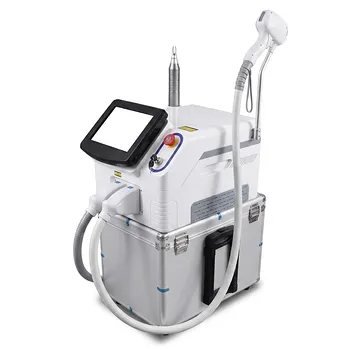
Clinical-grade laser and IPL platforms are more powerful, more configurable, and more closely supervised than consumer home devices. Their higher fluence, controlled pulse timing, wavelength selection, larger treatment areas, and integrated cooling allow clinicians to deliver more heat to the follicle while managing epidermal risk. Home devices deliberately use lower energy levels and simpler controls, making them safer for unsupervised use but generally less effective and less durable.
The central difference is controlled energy delivery: professional systems can generate clinically meaningful follicular injury under trained supervision, while home devices prioritize consumer safety and usually produce slower, less complete, and more maintenance-dependent hair reduction.
How the Technologies Differ
Laser delivers a specific wavelength
Professional lasers such as Alexandrite, diode, and Nd:YAG systems emit a defined wavelength selected for the target and the patient’s skin characteristics.
This concentrated optical output supports precise absorption by melanin in the hair shaft and follicle. Common examples include approximately 755 nm Alexandrite, diode wavelengths around the near-infrared range, and 1064 nm Nd:YAG systems.
IPL uses a broad spectrum
Intense Pulsed Light, or IPL, is not a laser. It produces a broad band of non-coherent light that is filtered to target a useful range of wavelengths.
IPL can be versatile, but its energy is less spectrally specific than a dedicated laser. Treatment performance therefore depends heavily on the filter, pulse structure, fluence, skin type, hair characteristics, and device design.
Home devices simplify optical control
Consumer products may use IPL or, less commonly, low-output laser technology. They typically restrict energy output, pulse options, treatment area, and user-adjustable settings.
These limits reduce the consequences of incorrect operation, but they also limit how deeply and consistently the device can heat the follicle.
Why Clinical Platforms Usually Produce Better Results
Higher fluence creates stronger follicular injury
Fluence is energy delivered per unit area, usually expressed in J/cm². Professional platforms can deliver substantially higher fluences than home devices, with some clinical systems operating across ranges such as approximately 10–60 J/cm², depending on the device, treatment area, skin type, and protocol.
Higher fluence can create sufficient thermal damage to reduce the follicle’s ability to produce hair. Home devices generally operate at lower fluences—often below the levels used clinically—to reduce burn risk during unsupervised treatment.
Pulse duration controls how heat is distributed
Professional systems allow clinicians to adjust pulse duration and related parameters according to hair thickness, follicle depth, skin pigmentation, and treatment area.
This matters because the objective is not simply to make the skin hot. The energy must be delivered in a way that preferentially damages the follicle while limiting unnecessary heating of surrounding tissue.
Clinical cooling permits more effective treatment
Medical aesthetic platforms commonly use contact cooling, chilled tips, sapphire windows, or other active cooling methods.
Cooling protects the epidermis and improves patient comfort while allowing the operator to use clinically effective settings. Home devices may include basic cooling or skin-contact sensors, but they generally lack the same cooling capacity and real-time professional adjustment.
Larger spot sizes improve treatment speed
Professional equipment commonly offers larger and more configurable spot sizes. This allows faster coverage and more consistent energy delivery across large areas such as the legs, back, or chest.
Home devices usually require more passes, more frequent sessions, or longer treatment periods to cover the same area.
What “Permanent” Hair Reduction Really Means
Clinical treatment is not guaranteed total hair eradication
Laser and IPL treatment should be described accurately as long-term or permanent hair reduction, not guaranteed permanent removal of every follicle.
Hair grows in cycles, and light-based treatment is most effective when follicles are in an active growth phase. Multiple scheduled sessions are therefore required, and maintenance treatments may be needed.
Home devices often delay regrowth
Lower-energy home treatment may weaken follicles or shift them into resting phases such as catagen or telogen. The practical result is often slower growth, finer hair, or temporary reduction rather than complete and durable follicular destruction.
This does not mean home devices are ineffective. It means their results are typically more modest, slower to develop, and more dependent on repeated maintenance.
Hair and skin characteristics affect both systems
Light-based hair removal works best when there is meaningful contrast between dark hair and lighter skin, because melanin is the primary target.
Blonde, gray, white, and some red hair types may respond poorly because they contain less of the relevant pigment. Darker skin can also require more conservative wavelength and fluence selection to reduce epidermal melanin absorption.
The Safety Difference Is About Control, Not Just Power
Professional systems carry higher inherent energy risk
Clinical platforms are more capable of causing burns, blistering, pigment changes, eye injury, or paradoxical hair growth if used incorrectly.
That higher risk is accepted because treatment is performed with skin assessment, parameter selection, protective eyewear, cooling, and clinical monitoring.
Professional supervision reduces avoidable errors
A trained provider can evaluate skin type, tanning status, medication use, pigmentary risk, hair characteristics, and contraindications before treatment.
The operator can also adjust settings during a course of treatment rather than relying on a fixed consumer program. This is particularly important for darker skin tones, recently tanned skin, or areas with variable pigmentation.
Home devices reduce output but cannot eliminate misuse
Lower fluence reduces the likelihood and severity of some injuries, but it does not make home treatment risk-free.
Users may treat recently tanned skin, ignore a manufacturer’s skin-tone limitations, repeatedly pass over one area, use a damaged device, or treat tattoos and pigmented lesions. Built-in skin sensors help, but they cannot replace a complete clinical assessment.
Eye protection remains important
Strong optical energy can injure the eye, especially when treating near the face. Professional laser systems require eyewear matched to the device’s emitted wavelength; IPL requires protection appropriate to its spectrum and operating conditions.
Users should follow the exact device instructions rather than assuming ordinary sunglasses provide adequate protection.
Regulatory and Evidence Differences
Clinical equipment is designed for supervised medical-aesthetic use
Professional systems are generally developed, tested, and regulated for use by trained operators within a clinical framework.
That framework includes device-specific protocols, operator training, maintenance, incident management, and patient documentation—factors that materially affect both safety and outcomes.
Consumer classification varies by jurisdiction
Home devices may be regulated differently from professional medical equipment and are often marketed primarily as beauty or personal-care products.
The regulatory category, permitted claims, and evidence requirements vary by country. A consumer device’s legal availability does not prove that it offers results equivalent to a clinical platform.
Marketing language requires careful interpretation
Claims such as “permanent hair removal,” “professional results,” or “salon-level power” may not have the same technical meaning across manufacturers.
The more reliable questions are: What technology is used? What output range is available? Is the device intended for the user’s skin and hair profile? What clinical evidence supports the claimed result?
Understanding the Trade-offs
Clinical systems exchange convenience for efficacy
Professional treatment usually requires appointments, a series of sessions, and a higher upfront cost.
In return, patients generally receive faster treatment, stronger follicular targeting, more individualized settings, and more durable reduction than home treatment can typically provide.
Home devices exchange efficacy for accessibility
Home devices offer privacy, convenience, and lower per-session cost. They may be useful for gradual reduction or maintenance after professional treatment.
Their limitations are slower progress, less consistent coverage, lower peak energy, and a greater dependence on user compliance.
Higher energy is not automatically better
Increasing fluence without appropriate wavelength, pulse duration, cooling, and skin assessment can increase injury without improving the result.
The goal is selective photothermolysis: delivering enough heat to the follicle while protecting the surrounding skin. Professional effectiveness comes from coordinated control of several parameters, not energy output alone.
IPL and laser should not be treated as interchangeable
Both can use melanin-targeted selective photothermolysis, but they are not identical technologies.
A dedicated laser may offer greater wavelength specificity for a particular clinical objective, while IPL can provide broader-spectrum treatment. The better option depends on skin type, hair characteristics, treatment area, operator expertise, and device design.
Making the Right Choice for Your Goal
The appropriate platform depends on whether your priority is maximum reduction, convenience, safety margin, or ongoing maintenance.
- If your primary focus is maximum long-term hair reduction: Choose professionally administered laser or IPL treatment with individualized wavelength, fluence, pulse-duration, and cooling decisions.
- If your primary focus is convenience and privacy: A reputable home device may provide gradual reduction, provided you follow its skin-tone, hair-color, patch-test, and treatment-frequency instructions.
- If your primary focus is safety with darker or recently exposed skin: Seek professional assessment rather than relying solely on a consumer device’s automatic sensor.
- If your primary focus is maintenance after clinical treatment: A home device may be useful for managing regrowth, but it should not be assumed to replace the original clinical course.
- If your primary focus is treating facial areas or pigmented skin: Obtain qualified guidance and use device-specific eye protection, because optical exposure and pigmentary risks are more consequential in these areas.
Professional platforms provide greater efficacy through controlled energy delivery, while home devices provide greater accessibility by deliberately sacrificing power and precision.
Summary Table:
| Aspect | Clinical Platforms | Home Devices |
|---|---|---|
| Fluence (J/cm²) | 10-60+ | Lower, typically <10 |
| Wavelength | Specific (755, 810, 1064 nm) | Broad spectrum or low-output laser |
| Cooling | Active (contact, chilled tip) | Basic or none |
| Spot Size | Larger, more consistent | Smaller, slower coverage |
| Supervision | Trained professional | Self-administered |
| Safety Features | Full clinical protocols, eye protection | Skin sensors, limited output |
| Effectiveness | Stronger follicular injury, durable reduction | Slower, more maintenance |
| Cost | Higher upfront, per session | Lower upfront, per device |
| Regulation | Medical device, strict | Consumer product, varied |
For professional-grade laser and IPL hair removal systems trusted by clinics and premium salons, choose BELIS. Our advanced platforms—featuring diode, Alexandrite, and Nd:YAG lasers—deliver the controlled power and safety features your clients need for effective, long-term results. With six FDA-approved technologies and global certifications, we support your practice with reliable equipment and expert guidance. Contact us today to learn how BELIS can elevate your hair removal services.
Related Products
- Professional IPL SHR Hair Removal Machine for Laser and IPL Hair Removal
- Clinic Use IPL SHR ND YAG Laser Hair Removal RF Skin Tightening Machine
- Clinic Use IPL and SHR Hair Removal Machine with Nd Yag Laser Tattoo Removal
- Diode Laser SHR Trilaser Hair Removal Machine for Clinic Use
- Trilaser Diode Hair Removal Machine for Beauty Clinic Use
People Also Ask
- What technical mechanisms are utilized in Intense Pulsed Light (IPL) hair removal systems to maximize targeted hair reduction while preventing epidermal thermal complications? Master IPL Hair Removal with Advanced Optical & Cooling Tech
- What spectral filter and pulse width adjustments maximize IPL hair removal efficacy and safety for Asian or darker skin phototypes? Discover the optimal IPL settings and protocols for safe, effective hair removal on darker skin.
- What main optical wavelengths and energy modalities are utilized in professional laser hair removal platforms, and how do they function across different skin types? Explore expert insights and advanced solutions.
- How does hair shaft diameter variation across different body sites impact treatment settings and thermal dynamics when using professional laser hair removal machines?
- How do standard laser hair removal devices (Diode, Alexandrite, Nd:YAG) compare with photodynamic light therapy for targeting different hair pigmentations? Discover the key differences and choose the right treatment for you.