
In short, yes. Modern laser hair removal technology has advanced significantly, making it a viable option for nearly all skin types. However, the effectiveness and, more importantly, the safety of the treatment are critically dependent on using the correct type of laser for your specific skin tone.
The suitability of laser hair removal has less to do with your skin type and more to do with the clinic's technology and the provider's expertise. For individuals with darker skin, selecting a facility with the appropriate long-wavelength laser is not just recommended—it is essential for preventing injury.
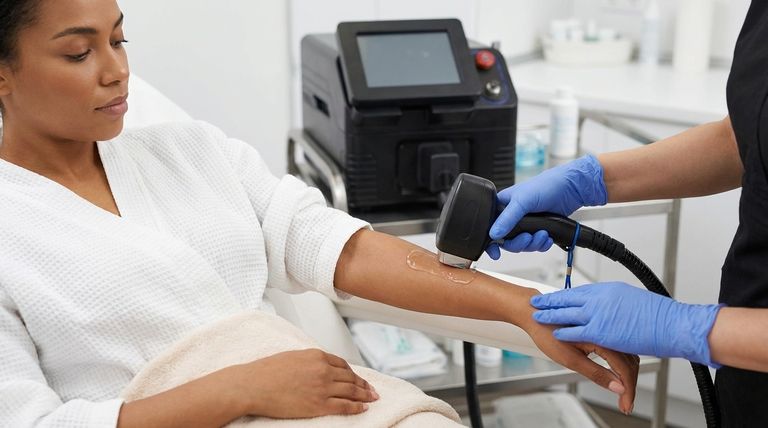
How Laser Hair Removal Works: The Role of Melanin
To understand why skin type matters, you must first understand the basic mechanism of the laser. The entire process hinges on a single target: melanin.
The Laser's Target
Lasers used for hair removal emit a highly concentrated beam of light. This light is specifically absorbed by the melanin, or pigment, within the hair follicle.
When the melanin absorbs this light energy, it converts to heat. This heat damages the follicle, inhibiting its ability to produce new hair.
The Original Challenge with Darker Skin
The core challenge is that melanin is present in both the hair and the skin. Darker skin tones naturally have a higher concentration of melanin in the epidermis (the skin's surface layer).
Early lasers could not effectively distinguish between the melanin in the hair and the melanin in the skin. For a person with darker skin, the laser would deliver energy to the skin and the hair indiscriminately, creating a significant risk of burns, scarring, or pigmentation changes.
The "Ideal" Contrast Principle
Historically, the ideal candidate for laser hair removal was someone with very light skin and very dark hair. This high-contrast combination made the hair follicle an easy and obvious target for the laser, with minimal risk of the surrounding skin absorbing the energy.
The Evolution of Lasers for All Skin Tones
The breakthrough for treating darker skin came from developing lasers that operate at different wavelengths. A longer wavelength is the key to a safer treatment for skin rich in melanin.
Early Lasers (Alexandrite & Diode)
Lasers like the Alexandrite (755nm) and many Diode (810nm) lasers have shorter wavelengths. This light is absorbed very effectively by melanin, making them excellent for light-skinned individuals (Fitzpatrick types I-III).
However, on darker skin, these shorter wavelengths are too readily absorbed by the melanin in the epidermis, making them high-risk.
The Gold Standard for Darker Skin (Nd:YAG)
The Nd:YAG laser is the technological solution for safely treating darker skin tones (Fitzpatrick types IV-VI). It operates at a much longer wavelength (1064nm).
This longer wavelength is less easily absorbed by the melanin in the skin's surface. It bypasses the epidermis and penetrates deeper to target the melanin concentrated in the hair follicle, dramatically reducing the risk of skin damage.
Understanding the Trade-offs and Risks
While modern technology is safe when used correctly, the risks of using the wrong technology or an inexperienced provider are real and significant.
The Primary Risk: Burns and Discoloration
Using an inappropriate laser (like an Alexandrite) or the wrong settings on a person with dark skin can cause the epidermis to overheat. This can result in painful burns, blisters, and permanent scarring.
Pigmentation Changes
Even if a burn doesn't occur, improper treatment can lead to pigmentation issues. Hyperpigmentation (dark spots) or hypopigmentation (light spots) can develop if the skin's melanocytes are damaged. These changes can take months or even years to resolve, and in some cases, can be permanent.
The Ineffectiveness of Treating Light Hair
It is crucial to note that laser hair removal is ineffective on hair with very little melanin. Blonde, grey, white, and most red hair do not have a sufficient pigment target for the laser to absorb, regardless of skin type.
How to Apply This to Your Treatment
Your role is not to be a laser expert, but to be an informed consumer. You can ensure your safety by asking the right questions and vetting your provider thoroughly.
Step 1: Verify the Technology
When you consult with a clinic, ask a direct question: "What types of lasers do you have, and which one would you use for my skin type?" If you have brown or black skin, the answer you are looking for is "Nd:YAG" or a "1064nm" laser. If they cannot provide a clear answer or only have shorter-wavelength lasers, you should not proceed.
Step 2: Vet the Provider's Experience
Ask the technician or medical professional about their specific experience treating clients with your skin tone. Ask to see before-and-after photos of previous clients with similar skin and hair. An experienced provider will be confident in their assessment and transparent about their technology.
Step 3: Insist on a Patch Test
Never commit to a full session without a patch test. A reputable provider will insist on performing one on a small, discreet area of skin to gauge how your skin will react to the chosen settings. This is a critical safety check.
Making the Right Choice for Your Goal
- If your primary focus is treating hair on light-to-olive skin: You have more flexibility with technology (Diode, Alexandrite), but provider expertise remains essential for optimal results.
- If your primary focus is treating hair on brown or black skin: Your safety is paramount. You must seek out a provider who uses a long-wavelength laser, specifically an Nd:YAG (1064nm).
- If your primary focus is treating blonde, grey, or red hair: Laser hair removal is unlikely to be effective, and you should consider alternative methods like electrolysis.
By arming yourself with this knowledge, you can navigate the process confidently and ensure you receive a safe and effective treatment.
Summary Table:
| Laser Type | Wavelength | Best For Skin Types (Fitzpatrick) | Key Consideration |
|---|---|---|---|
| Alexandrite | 755nm | I-III (Light to Olive) | High risk for darker skin |
| Diode | 810nm | I-III (Light to Olive) | Effective for light skin |
| Nd:YAG | 1064nm | IV-VI (Brown to Black) | Safest for dark skin |
Ready for safe, effective laser hair removal tailored to your skin type?
BELIS specializes in providing medical aesthetic clinics and premium beauty salons with advanced, skin-type-specific laser equipment like the Nd:YAG laser. Our technology ensures superior safety and results for all clients, especially those with darker skin tones.
Contact our experts today to learn how our professional medical aesthetic equipment can elevate your services and ensure client satisfaction.
Visual Guide

Related Products
- Clinic Use IPL SHR ND YAG Laser Hair Removal RF Skin Tightening Machine
- Clinic Use IPL and SHR Hair Removal Machine with Nd Yag Laser Tattoo Removal
- Q Switch Nd Yag Laser Machine Tattoo Removal Nd Yag Machine
- Diode Tri Laser Hair Removal Machine for Clinic Use
- Diode Laser SHR Trilaser Hair Removal Machine for Clinic Use
People Also Ask
- Why is the millisecond pulse width critical for laser hair removal on dark skin? Safety Guide for Dark Skin Treatments
- How does the combined application of laser devices and Eflornithine cream create a synergistic effect? Maximize Results
- What are the core hardware limitations of home hair removal devices? Why Professional Systems Deliver Superior Results
- Why is a 0–10 satisfaction scale used for hair management equipment? Elevate Your Clinic's Clinical Efficacy Metrics
- How long does a single laser hair removal session take? Fast & Effective Treatments for Your Busy Schedule










