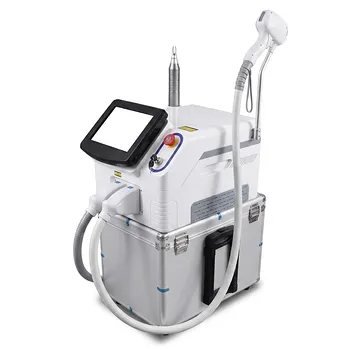
Combine ablative and vascular-specific lasers when a lesion contains both excess tissue and clinically important blood vessels. This is most relevant for benign lesions or organoid nevi with prominent red vascular components, substantial dermal vascularization, or a high risk of bleeding during tissue removal. The ablative laser reduces the bulky or thickened tissue, while a vascular laser—such as a long-pulsed 1,064 nm Nd:YAG or pulsed dye laser—targets the vessels.
The combination is indicated when one laser cannot adequately address the lesion’s two main components: tissue excess and vascularity. Ablation treats the structural bulk; vascular-selective treatment helps coagulate superficial or deeper vessels, improve hemostasis, and potentially optimize the cosmetic result.
When the Combination Is Clinically Useful
Benign lesions with prominent red vascular elements
Ablative treatment is appropriate when the lesion is raised, thickened, hyperplastic, or otherwise contains substantial tissue bulk. If the lesion also has visible erythema, telangiectasia, or red vascular nodules, adding vascular treatment can address the blood vessels that ablation alone may not control adequately.
This is particularly relevant when the vascular component is a major part of the lesion’s appearance or contributes to procedural bleeding.
Lesions with a high tendency to bleed
Vascular pretreatment or adjunctive treatment should be considered when the lesion contains numerous or large vessels and tissue vaporization is expected to expose them. Targeted photocoagulation can reduce bleeding from selected vessels and improve visualization during ablation.
The approach is not a substitute for appropriate surgical hemostasis or lesion assessment, but it can be useful when vascularity is a predictable procedural problem.
Organoid nevi with mixed tissue architecture
Organoid nevi may contain both abnormal epidermal or dermal structures and significant vascular elements. An ablative laser can remove the superficial or bulky component, while a vascular-specific wavelength treats the associated vessels.
Because these lesions can be heterogeneous, treatment planning should be based on the dominant clinical and anatomical components rather than applying a fixed dual-laser protocol.
Thickened vascular lesions or angiokeratoma-like lesions
When marked hyperkeratosis or epidermal thickening overlies diseased vessels, the superficial tissue can limit access of vascular laser energy. Fractional or fully ablative CO2 treatment may reduce that barrier before vascular treatment is applied.
This rationale is especially relevant in chronic, thickened lesions such as angiokeratoma, where treating the surface alone may not adequately reach the underlying vessels.
Choosing the Vascular Laser
Long-pulsed Nd:YAG for deeper or larger vessels
A long-pulsed 1,064 nm Nd:YAG laser is useful when vessels are relatively deep, large, or resistant to more superficial vascular wavelengths. Its greater penetration can make it appropriate for deeper vascular components that are not effectively reached by shorter-wavelength devices.
It may also be used selectively for persistent hypertrophic vascular nodules within mature vascular lesions, provided the lesion and treatment target are appropriately assessed.
Pulsed dye laser for superficial vascularity
Pulsed dye lasers, commonly using wavelengths around 595 nm, are generally better suited to superficial capillary vessels, diffuse erythema, and superficial telangiectasias. They may be preferable when the vascular component is primarily superficial rather than deep or nodular.
The choice depends on vessel depth, diameter, color, lesion thickness, and the patient’s skin characteristics.
Sequential treatment for different depths
A superficial vascular treatment may be performed before a deeper wavelength when the lesion contains vessels at multiple levels. Reducing superficial vascular absorption can, in some settings, permit more effective delivery of subsequent energy to deeper targets.
However, sequential treatment should be based on a clear optical and clinical rationale, not simply on the assumption that more laser modalities will produce a better result.
How the Two Modalities Complement Each Other
Ablation removes the structural component
CO2 and Erbium:YAG lasers vaporize or ablate tissue. They are therefore useful for reducing raised, thickened, hyperplastic, or superficial lesion components.
Their main limitation in this context is that they do not selectively target blood vessels. Ablation may expose vascular channels without providing the same degree of vessel-specific coagulation as a vascular laser.
Vascular treatment targets the blood supply
Vascular-specific lasers preferentially deliver energy to hemoglobin-containing structures. The resulting photothermal effect can coagulate selected vessels while limiting unnecessary treatment of surrounding tissue.
This can be valuable for both visible vascular clearance and procedural control of bleeding, although the degree of hemostatic benefit depends on vessel size, depth, fluence, pulse duration, and lesion characteristics.
The sequence should reflect the lesion
If thick epidermal tissue blocks access to deeper vessels, ablation may reasonably precede vascular treatment. If bleeding risk is the primary concern, vascular coagulation may be considered before or during tissue removal.
There is no universally correct sequence; it should follow the lesion’s architecture and the intended treatment endpoint.
When a Vascular Laser May Not Be Necessary
Lesions with little visible vascularity
Ablation alone may be sufficient when a lesion is primarily keratotic, fibrous, or hyperplastic and lacks meaningful erythema, telangiectasia, or bleeding tendency. Adding vascular treatment in this setting may increase complexity without addressing a significant clinical problem.
Purely superficial vascular lesions
A vascular laser may be the primary treatment when the lesion is mainly a superficial capillary abnormality and there is no substantial tissue bulk to remove. Ablative treatment would then add unnecessary epidermal injury.
Uncertain or atypical lesions
Laser treatment should not be used to bypass diagnostic uncertainty. A changing, asymmetric, ulcerated, painful, or otherwise atypical lesion may require clinical evaluation and, when indicated, biopsy before destructive treatment.
Understanding the Trade-offs
More modalities mean more treatment variables
Combining lasers increases the number of parameters that must be controlled, including wavelength, pulse duration, energy, spot size, treatment sequence, and cooling. Poor coordination can increase the risk of burns, scarring, pigmentary change, prolonged erythema, or incomplete treatment.
Vascular targeting is not automatically hemostatic
Vascular lasers can coagulate selected vessels, but they do not guarantee bloodless ablation. Deep, large, or atypical vessels may respond incompletely, and standard methods of bleeding control must remain available.
Cosmetic improvement is not guaranteed
Treating both the tissue bulk and vascular component may improve contour and color more comprehensively than treating either component alone. Nevertheless, recurrence, residual vascularity, textural change, and pigmentary complications remain possible.
Conservative staging may be safer
For extensive, deeply vascular, or anatomically sensitive lesions, staged treatment can be preferable to aggressive same-session ablation and vascular treatment. Staging allows the response, healing, and vascular persistence to be assessed before additional energy is delivered.
Applying This to Clinical Decision-Making
The key question is whether the lesion has two treatable problems: a structural tissue component and a vascular component.
- If your primary focus is reducing bulky or thickened tissue: Use an ablative laser as the main modality, adding vascular treatment only when visible vascularity or bleeding risk is clinically significant.
- If your primary focus is controlling superficial erythema or telangiectasia: Consider a superficial vascular laser such as pulsed dye laser, with ablation reserved for genuine tissue thickening or excess.
- If your primary focus is deeper, larger, or resistant vessels: Consider a long-pulsed Nd:YAG device when the vascular targets are beyond the effective depth of more superficial wavelengths.
- If your primary focus is treating a thickened vascular lesion: Consider sequential or staged ablation and vascular treatment after confirming that the lesion’s diagnosis and anatomy support a dual-modality approach.
- If your primary focus is safety in an atypical lesion: Establish the diagnosis first and avoid destructive laser treatment until malignancy or another contraindication has been appropriately excluded.
The most defensible dual-laser strategy matches ablation to tissue excess and vascular-selective treatment to the depth, size, and clinical importance of the vessels.
Summary Table:
| Indication | Description |
|---|---|
| Benign lesions with red vascular elements | Raised lesions with visible erythema or telangiectasia; ablation removes bulk, vascular laser targets vessels. |
| High bleeding tendency | Lesions with numerous or large vessels; vascular pretreatment reduces bleeding during ablation. |
| Organoid nevi | Mixed tissue architecture with both structural and vascular components; combination addresses both. |
| Thickened vascular lesions | Hyperkeratosis overlying vessels; ablation removes barrier, vascular laser treats underlying vessels. |
| When vascular laser not needed | Lesions with minimal vascularity or purely superficial vascular lesions; ablation alone or vascular alone may suffice. |
Enhance your clinic's treatment capabilities with BELIS's advanced laser systems, including long-pulsed Nd:YAG and CO2 fractional lasers. Our professional-grade equipment is designed for clinics and premium salons, ensuring safe and effective combination therapies. Contact us today to learn how our technology can elevate your practice and patient outcomes. Contact us now.
Related Products
- Fractional CO2 Laser Machine for Skin Treatment
- 808nm Diode Laser Hair Removal Machine 755+808+1064nm Mixed Wavelength Professional Equipment
- Diode Laser SHR Trilaser Hair Removal Machine for Clinic Use
- Trilaser Diode Hair Removal Machine for Beauty Clinic Use
- 808nm Diode Laser Hair Removal Machine and Equipment with Picolaser Arm
People Also Ask
- What is the technical principle behind CO2 Laser Fractional micro-perforations? Master Scar Revision Mechanics
- What parameters and treatment intervals are advised when applying fractional CO2 laser technology to delicate periorbital skin laxity? Discover safe protocols for eyelid rejuvenation.
- How do energy-based modalities complement injectable neurotoxins in décolleté rejuvenation? Explore synergistic benefits.
- What is the primary function of a high-precision fractional CO2 laser system for GSM? Restore Vaginal Health Naturally
- Why do fractional CO2 laser parameters need to be differentiated? Master Keloid vs. Hypertrophic Scar Treatment