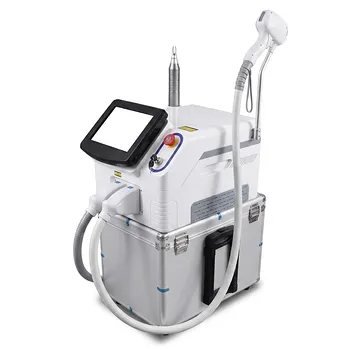
For Fitzpatrick IV–VI, prioritize epidermal safety by choosing a longer wavelength and a pulse duration appropriate to the hair follicle, device, and cooling system. In practice, long-pulsed 1064 nm Nd:YAG is generally the most conservative wavelength choice for deeply pigmented skin, while approximately 800–810 nm diode systems may also be appropriate when the device is validated for these phototypes. Pulse duration should usually be extended into the millisecond range and paired with moderated fluence, effective cooling, and test spots rather than selected as an isolated setting.
The key principle is to reduce competitive absorption by epidermal melanin while delivering enough controlled heat to the follicle. Longer wavelengths generally improve the safety margin, but there is no universal pulse duration or fluence for every client, device, body site, or hair type.
Why Darker Skin Requires Different Settings
Epidermal melanin competes with follicular melanin
Laser hair removal relies on selective photothermolysis: melanin in the hair absorbs light, converts it to heat, and transfers that heat to follicular structures.
In Fitzpatrick IV–VI, the epidermis also contains substantial melanin. It can absorb part of the laser energy before it reaches the follicle, increasing the risk of burns, blistering, epidermal injury, and post-inflammatory hyperpigmentation.
The objective is controlled follicular heating
The goal is not simply to use the highest available energy. Practitioners must deliver sufficient follicular heating while keeping the epidermis below its injury threshold.
This requires coordinating wavelength, pulse duration, fluence, spot size, repetition pattern, and cooling. Changing one parameter without reassessing the others can reduce the safety margin.
Selecting the Wavelength
Prefer longer wavelengths for phototypes IV–VI
Longer wavelengths generally penetrate more deeply and are absorbed less strongly by epidermal melanin than shorter wavelengths.
For this reason, commonly considered options include:
- 1064 nm long-pulsed Nd:YAG: Often preferred for Fitzpatrick V–VI and for clients with substantial epidermal pigmentation.
- 800–810 nm diode: May be effective for darker skin, particularly with dark, coarse hair, provided the system is designed and cleared for the intended use.
- 940 nm diode: May be available on some systems and can offer deeper penetration, but settings must follow the specific device’s validated protocol.
Use shorter wavelengths cautiously
Alexandrite around 755 nm, ruby around 694 nm, and shorter IPL filter ranges have greater melanin absorption and therefore a narrower safety margin in darker skin.
They should not be treated as interchangeable with Nd:YAG or diode systems. A device’s intended phototype range, cooling technology, pulse structure, and manufacturer protocol must determine whether it is appropriate.
Match wavelength to hair and skin contrast
Dark, coarse hair provides a stronger chromophore target and is generally more responsive than fine or lightly pigmented hair.
When both the hair and epidermis are deeply pigmented, the practitioner should favor the wavelength and delivery mode that minimize epidermal absorption. Fine, gray, red, or blond hair may respond poorly because it contains insufficient melanin for reliable selective photothermolysis.
Choosing Pulse Duration
Use millisecond pulses suited to the follicle
Pulse duration should be long enough to reduce the peak surface heating rate while maintaining effective thermal injury in the follicle.
For many systems, this means using longer millisecond pulses, often approximately 10–50 ms for medium-to-coarse hair, subject to the device’s validated treatment parameters. Some systems provide substantially longer pulses, including several hundred milliseconds, but a value such as 400 ms should not be treated as a universal requirement.
Consider hair diameter and treatment site
Coarse terminal hairs can generally tolerate and require different heating behavior than fine hairs. Pulse duration should therefore be selected with the hair diameter, follicular depth, body site, and treatment area in mind.
The same pulse duration may not be appropriate for a beard, axilla, bikini area, leg, or fine facial hair. Device-specific presets can help, but they do not replace assessment of the client and treatment endpoint.
Avoid interpreting “longer” as “automatically safer”
Extending the pulse can lower the instantaneous thermal load, but excessive duration or excessive cumulative energy can still injure the epidermis.
Pulse duration must be evaluated together with fluence and cooling. Multi-pulsing with adequate interpulse delays may be used on some IPL or laser platforms, but only when the system’s protocol supports it.
Pair Parameters With Epidermal Protection
Moderate fluence during initial treatment
For darker skin, initial treatment should generally begin conservatively within the manufacturer’s permitted range, particularly when the client is new to the device or has recently changed treatment areas.
The practitioner can assess the response and adjust subsequent treatments based on a clinically appropriate endpoint rather than pursuing aggressive immediate energy delivery.
Use active cooling continuously
Contact cooling, cooled sapphire tips, or dynamic cold-air systems can reduce epidermal heating before, during, and after the pulse.
Cooling is a key part of the treatment system, not an optional substitute for appropriate wavelength and fluence. The practitioner should verify that cooling is functioning correctly and is compatible with the selected device settings.
Establish a treatment endpoint
A controlled perifollicular response may indicate effective delivery, but excessive pain, whitening, gray discoloration, blistering, epidermal denaturation, or persistent erythema indicates unacceptable injury risk.
The absence of immediate visible change does not justify rapid escalation. Pigmentary complications can appear later, especially in recently tanned or inflammation-prone skin.
Screen Before Treating
Assess recent tanning and pigment instability
Recent sun exposure, tanning-bed use, or intentional tanning increases epidermal melanin and narrows the treatment margin.
Treatment should be postponed or parameters reconsidered according to the device protocol until the skin has returned to a stable baseline. The client should also follow appropriate pre- and post-treatment sun-avoidance measures.
Perform a test spot
A test pulse or test area in an inconspicuous location is an important risk-control step for darker phototypes, especially when treating a new body site, recently tanned skin, or an unfamiliar hair pattern.
The response should be assessed according to the device protocol before treating a larger area. Delayed pigmentary reactions should also be considered rather than relying only on the immediate appearance.
Obtain focused informed consent
Consent should cover the increased risk of burns, blistering, temporary or persistent pigmentary changes, and post-inflammatory hyperpigmentation in darker skin.
For facial treatment, particularly along the jawline or other areas with fine vellus hair, clients should also be informed about the uncommon possibility of paradoxical hypertrichosis.
Understanding the Trade-offs
Nd:YAG improves epidermal safety but may feel less efficient
The 1064 nm wavelength has lower epidermal melanin absorption and deeper penetration, which often makes it the preferred option for phototypes V–VI.
Its lower melanin absorption can also mean that treatment may require careful optimization and that results may be less rapid than with shorter, more strongly absorbed wavelengths in lighter skin.
Diode systems require platform-specific judgment
An 800–810 nm diode can be effective for darker skin, especially with coarse, dark hair and robust cooling.
However, “diode” is not a single standardized treatment profile. Spot size, pulse architecture, cooling, fluence limits, and manufacturer validation vary substantially between systems.
More energy is not a substitute for better targeting
Increasing fluence to compensate for a long wavelength, fine hair, or a weak immediate response can raise epidermal risk without producing useful follicular damage.
If the hair lacks sufficient pigment, the fundamental limitation may be target absorption rather than insufficient energy.
IPL requires particular caution
IPL emits a broad spectrum rather than one discrete wavelength. For darker skin, practitioners should use an appropriate higher cutoff filter, longer pulses, conservative fluence, suitable interpulse delays, and effective cooling only when those options are validated for the device.
Shorter cutoff filters and aggressive single-pulse delivery can increase epidermal melanin absorption and thermal injury risk.
Applying This to Clinical Practice
The final settings must come from the specific device’s instructions for use, the client assessment, and the practitioner’s training and scope of practice.
- If your primary focus is maximum epidermal safety: Prefer a validated long-pulsed 1064 nm Nd:YAG protocol, with conservative initial fluence, an extended millisecond pulse, continuous cooling, and a test spot.
- If your primary focus is treating coarse, dark hair efficiently: Consider a validated 800–810 nm diode or 1064 nm Nd:YAG system, selecting pulse duration according to hair diameter, site, cooling capacity, and the manufacturer’s protocol.
- If your primary focus is treating Fitzpatrick V–VI: Favor 1064 nm Nd:YAG and avoid assuming that shorter-wavelength alexandrite, ruby, or IPL settings can be transferred safely.
- If your primary focus is using IPL: Select the longest appropriate cutoff range and a longer-pulse, lower-peak-energy protocol with adequate interpulse delay and cooling, only where the platform is approved for that phototype.
- If your primary focus is reducing complications: Defer treatment after recent tanning, perform a test spot, document the response, and monitor for delayed pigmentary changes before increasing treatment intensity.
Safe treatment of darker skin depends on coordinated parameter selection, validated equipment protocols, and disciplined clinical observation rather than wavelength or pulse duration alone.
Summary Table:
| Parameter | Recommendation | Rationale |
|---|---|---|
| Wavelength | Prefer 1064 nm Nd:YAG; consider 800-810 nm diode | Longer wavelengths reduce epidermal melanin absorption, lowering burn risk |
| Pulse Duration | Use millisecond pulses (approx. 10-50 ms for coarse hair) | Longer pulses reduce peak heating while still damaging follicles |
| Fluence | Start conservatively within manufacturer's range | Moderate fluence minimizes risk of epidermal injury |
| Cooling | Use active cooling (contact, cold air, etc.) | Protects epidermis during and after pulse |
| Test Spot | Always perform test pulse | Assesses skin response before full treatment, especially for darker phototypes |
Discover the ideal laser platform for your clinic and master safe protocols for all skin types. At BELIS, we specialize in professional-grade medical aesthetic equipment tailored for clinics and premium salons. Our advanced systems—including diode and Nd:YAG lasers—are engineered with superior cooling and customizable settings to optimize safety and efficacy for Fitzpatrick IV–VI skin. Partner with us to elevate your practice and deliver exceptional results. Speak with our experts today to find the perfect solution for your needs—contact us now!
Related Products
- 808nm Diode Laser Hair Removal Machine 755+808+1064nm Mixed Wavelength Professional Equipment
- 808nm Diode Laser Hair Removal Machine and Equipment with Picolaser Arm
- Tri Laser Diode Hair Removal Machine Professional Beauty Equipment
- Diode Laser SHR Trilaser Hair Removal Machine for Clinic Use
- Diode Tri Laser Hair Removal Machine for Clinic Use
People Also Ask
- How do 800/810 nm diode hair removal lasers compare to 1064 nm long-pulsed Nd:YAG lasers? Discover the Best for Your Patients
- How do broad-spectrum noncoherent light sources compare to single-wavelength diode lasers in aesthetic hair removal applications? Find the best fit for your clinic.
- How can aesthetic practitioners prevent side effects like paradoxical hair regrowth and thermal burns when performing diode laser hair removal on dark skin? Master safe protocols for Fitzpatrick IV–VI skin.
- Why is monitoring the revenue rate per hour per physician essential when deciding to invest in high-throughput aesthetic technology like diode hair removal lasers or multi-applicator body sculpting machines? Optimize your practice's profitability
- What are the clinical trade-offs between high single-pulse fluences and pulse stacking in diode laser hair removal? Find optimal settings for safe, effective outcomes.