
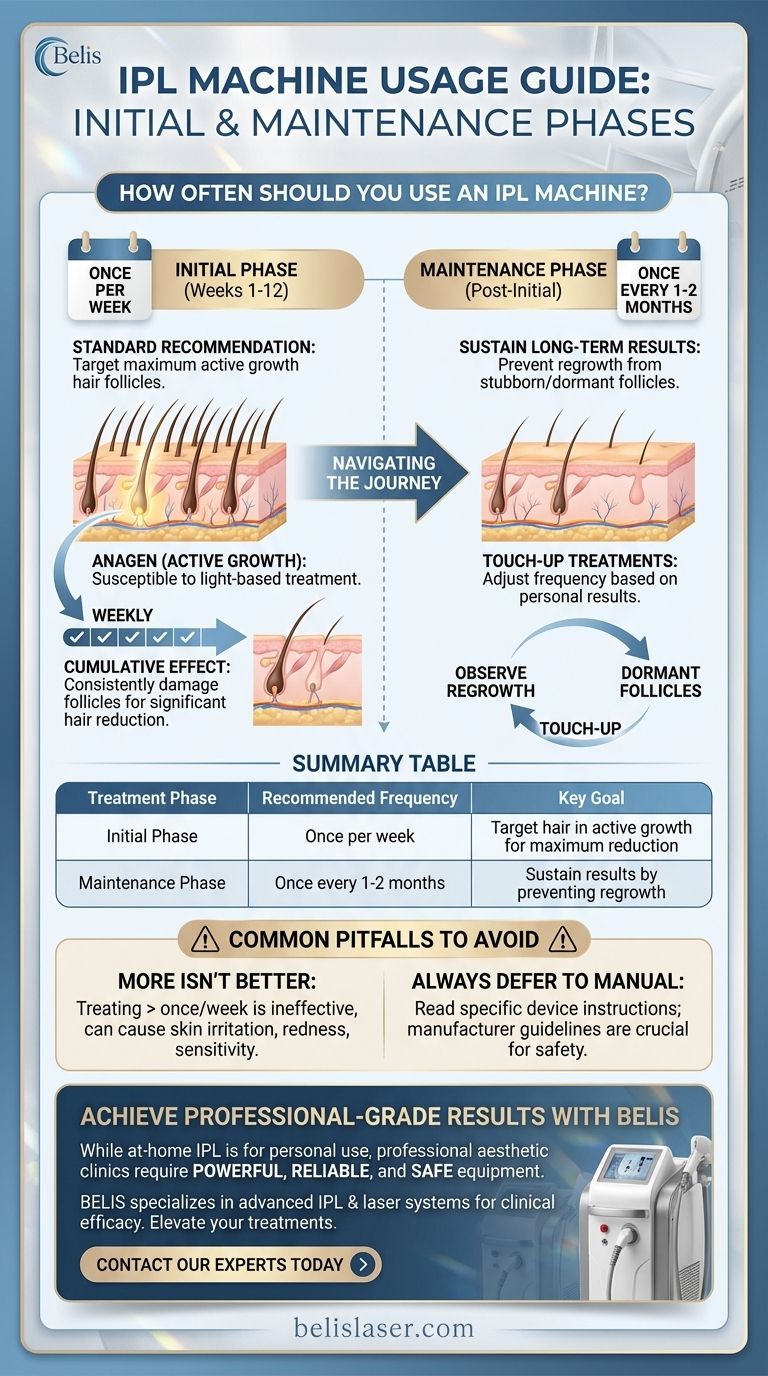
For most at-home IPL devices, the standard recommendation is to perform one treatment per week during the initial phase. This schedule is specifically designed to target the maximum number of hair follicles while they are in their active growth cycle, which is the only time they are susceptible to light-based treatment.
The key to successful IPL hair removal is understanding it as a two-stage process. A consistent, initial weekly phase is required to actively reduce hair growth, which is then followed by a less frequent maintenance phase to sustain long-term results.
Why a Weekly Schedule is the Standard
To use your device effectively, it's important to understand the principles behind the recommended frequency. The "once-a-week" rule isn't arbitrary; it's based on the biology of hair growth and the technology of at-home devices.
Aligning with the Hair Growth Cycle
Your hair grows in three phases: anagen (active growth), catagen (transition), and telogen (resting). IPL is only effective on hairs in the anagen phase, when the hair is actively connected to its follicle.
Because not all hairs are in the anagen phase at the same time, multiple sessions are required. A weekly schedule increases the probability of catching each hair follicle during its active growth window over the course of several weeks.
The Cumulative Effect on Follicles
A single IPL treatment weakens the hair follicle, but it rarely disables it permanently. Consistent, repeated treatments have a cumulative effect, progressively damaging the follicle's ability to regrow hair.
Sticking to a weekly schedule ensures you are consistently applying this pressure, leading to more significant and lasting hair reduction.
Navigating the Two Phases of Treatment
Your IPL journey isn't a single, monolithic routine. It evolves as you see results, moving from an aggressive initial phase to a simple maintenance plan.
The Initial Phase (e.g., Weeks 1-12)
This is the active reduction stage. During this period, you should treat the desired area once per week.
The goal here is to treat as many follicles as possible in their growth phase to achieve the most significant hair reduction. Most users see noticeable results within the first 4-6 weeks and significant results by the end of this phase.
The Maintenance Phase (Post-Initial Phase)
Once you are satisfied with the initial hair reduction, you can scale back the frequency significantly. At this point, you are no longer trying to eliminate hair but simply preventing regrowth from any stubborn or dormant follicles.
For most users, this means performing a touch-up treatment once every 1 to 2 months, or as you notice any fine regrowth. You can and should adjust this schedule based on your personal results.
Common Pitfalls to Avoid
Understanding what not to do is just as important as knowing the correct frequency. More treatments do not equal faster results and can compromise the safety and health of your skin.
Why More Isn't Better
Treating the same area more than once a week is ineffective and ill-advised. The hair follicle needs time to go through its cycle, and treating it more often doesn't speed this up.
Over-treating can lead to unnecessary skin irritation, redness, and sensitivity without providing any additional benefit to your hair removal goals.
Always Defer to Your Device's Manual
While once a week is the common standard, you must read the instruction manual for your specific device.
Some brands may have slightly different recommendations based on their technology and power output. The manufacturer's guidelines are your most important source of information for safe and effective operation.
Making the Right Choice for Your Goal
Your treatment schedule should adapt as you progress. Use these guidelines to tailor your routine to the current state of your hair growth.
- If you are just starting (Weeks 1-12): Stick to a consistent schedule of one treatment per week to effectively target hair in its active growth phase.
- If you have achieved significant hair reduction: Transition to a maintenance phase, treating the area once every 1-2 months to keep follicles dormant.
- If you experience any skin irritation: Pause your treatments immediately and allow your skin to fully recover before attempting your next session.
Following this structured approach allows you to achieve and maintain smooth skin safely and effectively.
Summary Table:
| Treatment Phase | Recommended Frequency | Key Goal |
|---|---|---|
| Initial Phase (Weeks 1-12) | Once per week | Target hair in active growth for maximum reduction |
| Maintenance Phase | Once every 1-2 months | Sustain results by preventing regrowth |
Achieve professional-grade results with equipment from BELIS.
While at-home IPL devices are great for personal use, medical aesthetics clinics and premium beauty salons require powerful, reliable, and safe professional equipment to deliver superior results to their clients.
BELIS specializes in professional medical aesthetic equipment, including advanced IPL and laser systems designed for clinical efficacy and safety. Our machines offer greater power, precision, and durability to help your business build trust and achieve outstanding patient outcomes.
Ready to elevate your treatments? Contact our experts today to find the perfect professional solution for your clinic.
Visual Guide
Related Products
- IPL SHR+Radio frecuency machine
- IPL SHR Hair Removal Machine for Permanent Hair Removal
- Clinic Use IPL and SHR Hair Removal Machine with Nd Yag Laser Tattoo Removal
- Clinic Use IPL SHR ND YAG Laser Hair Removal RF Skin Tightening Machine
- Trilaser Diode Hair Removal Machine for Beauty Clinic Use
People Also Ask
- In what ways is an IPL SHR machine considered a cost-effective solution for hair removal? Maximize Your Clinic's ROI
- What is the typical downtime and recovery period associated with IPL SHR treatments? Zero-Downtime Guide
- What types of skin rejuvenation concerns can be addressed using IPL SHR machines? Master Photofacials & Anti-Aging
- What factors contribute to the speed and efficiency of IPL SHR treatments for large body areas? Boost Clinic Throughput
- What are the technical advantages of using the SHR mode in IPL systems? Discover Pain-Free, Safe Hair Removal













