
For most people, diode laser hair removal provides a significant hair reduction that lasts for several months or even years. After completing the necessary initial sessions, typically between two and six, the vast majority of treated hair follicles are permanently disabled.
The crucial distinction to understand is that diode laser hair removal provides permanent hair reduction, not complete and permanent hair removal. While many hairs are gone for good, some follicles may eventually recover and produce new, finer hair, making occasional maintenance treatments a normal part of the process.

How Diode Lasers Achieve Long-Term Results
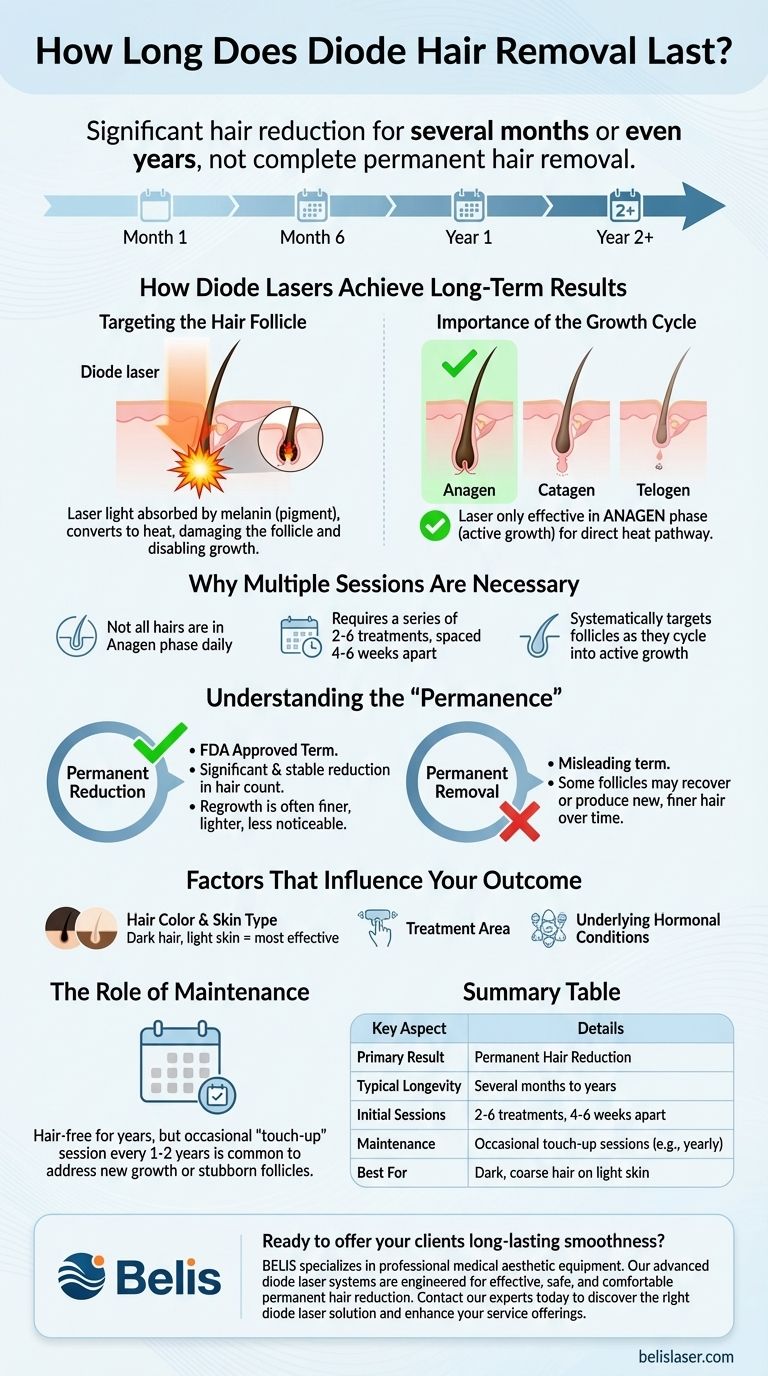
To understand the longevity of the results, you must first understand the mechanism. Diode lasers work by targeting the pigment (melanin) within the hair shaft.
Targeting the Hair Follicle
The laser emits a highly concentrated beam of light at a specific wavelength. This light is absorbed by the melanin, instantly converting to heat.
This intense, localized heat travels down the hair shaft to the follicle, damaging the key structures responsible for hair growth without harming the surrounding skin.
The Importance of the Growth Cycle
Hair grows in three phases: anagen (active growth), catagen (transition), and telogen (resting). A laser can only effectively destroy a follicle when the hair is in the anagen phase.
During this active phase, the hair is physically connected to the base of the follicle, providing a direct pathway for the laser's heat to do its job.
Why Multiple Sessions Are Necessary
On any given day, only a certain percentage of your hair is in the anagen phase. This is why a single treatment is never enough.
To achieve a significant reduction, you need a series of treatments, typically spaced 4-6 weeks apart. This schedule is designed to systematically target and disable follicles as they cycle into their active growth phase.
Understanding the "Permanence" of Laser Hair Removal
The term "permanent" can be misleading. The FDA approves the term "permanent hair reduction," which is a more accurate description of the outcome.
What Permanent Reduction Means
This refers to a significant and stable reduction in the number of hairs regrowing in a treated area after the initial treatment course.
The hairs that do regrow are often much finer, lighter, and less noticeable than before. For many, this result is functionally equivalent to permanent removal.
Factors That Influence Your Outcome
Results are not universal and can be influenced by several factors. These include your hair color, skin type, the treatment area, and underlying hormonal conditions.
Individuals with dark, coarse hair and light skin typically see the most dramatic and long-lasting results because the contrast allows the laser to target the hair follicle most effectively.
The Role of Maintenance
After completing your initial series of 2-6 treatments, you may be hair-free for years. However, it's common to require a maintenance or "touch-up" session once every year or two.
These sessions address any new hair growth that may be stimulated by hormonal changes or treat the few stubborn follicles that were not fully disabled initially.
Making the Right Choice for Your Goal
Understanding the process and setting realistic expectations are key to being satisfied with your diode laser hair removal results.
- If your primary focus is a dramatic, long-term reduction in shaving and waxing: Diode laser is an excellent and highly effective solution when you commit to the full initial course of treatments.
- If your primary focus is a one-time, 100% permanent solution with zero future upkeep: You should adjust your expectations, as the standard for success involves occasional maintenance sessions to preserve a perfectly smooth result.
By viewing it as a powerful and lasting process of hair reduction, you can achieve the significant, long-term smoothness you are looking for.
Summary Table:
| Key Aspect | Details |
|---|---|
| Primary Result | Permanent Hair Reduction |
| Typical Longevity | Several months to years |
| Initial Sessions | 2-6 treatments, 4-6 weeks apart |
| Maintenance | Occasional touch-up sessions (e.g., yearly) |
| Best For | Dark, coarse hair on light skin |
Ready to offer your clients long-lasting smoothness?
BELIS specializes in professional medical aesthetic equipment, serving medical aesthetics clinics and premium beauty salons. Our advanced diode laser systems are engineered for effective, safe, and comfortable permanent hair reduction, helping you deliver outstanding results and build client loyalty.
Contact our experts today to discover the right diode laser solution for your business and enhance your service offerings.
Visual Guide
Related Products
- Clinic Diode Laser Hair Removal Machine with SHR and Trilaser Technology
- Diode Tri Laser Hair Removal Machine for Clinic Use
- Trilaser Diode Hair Removal Machine for Beauty Clinic Use
- Diode Laser SHR Trilaser Hair Removal Machine for Clinic Use
- IPL SHR Hair Removal Machine for Permanent Hair Removal
People Also Ask
- How can aesthetic practitioners prevent side effects like paradoxical hair regrowth and thermal burns when performing diode laser hair removal on dark skin? Master safe protocols for Fitzpatrick IV–VI skin.
- How do broad-spectrum noncoherent light sources compare to single-wavelength diode lasers in aesthetic hair removal applications? Find the best fit for your clinic.
- What are the advantages of the Constant Motion Technique? Elevate Your Clinic's Laser Hair Removal Results
- Why can traditional high-energy pulse (HR) modes lead to adverse skin reactions? Understanding Thermal Injury Risks
- Why is a 40-ms pulse width critical for Fitzpatrick skin types III-V? The Key to Safe & Effective Laser Hair Removal







