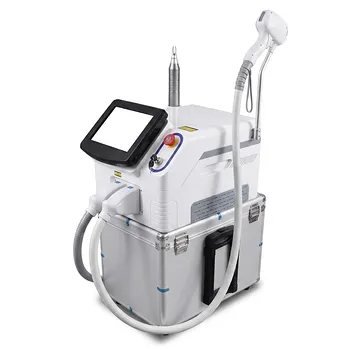
Picosecond lasers achieve subsurface optical breakdown by concentrating extremely short, high-peak-power pulses inside targeted skin structures. Because the energy arrives in trillionths of a second, it produces a localized plasma, pressure wave, and microscopic vacuole before substantial heat can spread into surrounding tissue. This photomechanical process can fragment pigment while also creating controlled dermal remodeling signals, with substantially less thermal injury than conventional ablative resurfacing.
The central principle is peak power without prolonged heating: focused picosecond pulses trigger laser-induced optical breakdown (LIOB) in microscopic treatment zones, separating the desired mechanical effect from widespread thermal damage.
How Picosecond Pulses Create Optical Breakdown
Extremely Short Pulses Produce High Peak Power
A laser pulse’s peak power depends on its energy divided by its duration:
[ P_p = \frac{E_p}{\tau_p} ]
When the pulse duration falls into the picosecond range, the same amount of energy is delivered far more rapidly. This creates a very high instantaneous intensity at the focused treatment point.
Focusing Raises the Local Intensity
Picosecond systems can focus light beneath the skin surface or use a diffractive lens array to divide the beam into many concentrated micro-beams. These micro-beams create high-intensity focal zones surrounded by areas receiving much lower energy.
The result is a pattern of controlled microscopic treatment points rather than uniform heating across the entire skin surface.
Plasma and Vacuoles Form at the Focus
At sufficient intensity, the focused light ionizes a small volume of tissue and forms a transient plasma. Its rapid expansion generates a mechanical shockwave and may produce a microscopic steam bubble, creating an intraepidermal or dermal vacuole.
This event is called laser-induced optical breakdown, or LIOB. The surrounding tissue is largely spared because the breakdown is confined to the focal volume.
Why Significant Thermal Damage Is Limited
Energy Arrives Faster Than Heat Can Spread
Thermal injury requires heat to remain in tissue long enough to diffuse into nearby structures. Picosecond pulses end before meaningful thermal conduction occurs over a substantial distance.
This is the practical distinction between a localized photomechanical event and conventional laser heating: the pulse creates pressure and structural disruption first, while limiting the time available for heat to accumulate.
Average Power Remains Relatively Low
Although instantaneous peak power can be very high, average power depends on pulse energy multiplied by repetition rate:
[ P_{\text{ave}} = E_p \times f_p ]
A system can therefore produce intense, brief focal events without continuously depositing large amounts of heat into the surrounding skin. This reduces collateral thermal damage, although it does not eliminate all heat or treatment-related inflammation.
Low-Fluence Background Protects Adjacent Tissue
With a diffractive lens array, much of the clinically relevant energy is concentrated into focal micro-zones, while the surrounding background receives lower fluence. This fractional distribution helps preserve untreated tissue between treatment points.
Those untreated areas support re-epithelialization and recovery, contributing to limited downtime compared with more aggressive resurfacing procedures.
How Pigment Is Cleared
Pigment Absorbs the Laser Energy
Melanin or tattoo pigment absorbs the selected wavelength. Common picosecond platforms use wavelengths such as 755 nm or 1064 nm, but the appropriate wavelength depends on the pigment, skin type, depth, and clinical target.
The laser is adjusted so that energy reaches the target while minimizing unnecessary exposure to surrounding tissue.
Mechanical Stress Fragments the Pigment
The rapid absorption creates a pressure wave and localized optical breakdown. This mechanical stress breaks pigment-containing structures into smaller fragments rather than relying primarily on prolonged heating to destroy them.
The fragments can then be progressively removed through the body’s natural clearance mechanisms. The speed and completeness of clearance vary with pigment type, depth, location, immune response, and treatment parameters.
Fractional Delivery Limits the Injury Footprint
A diffractive lens array can distribute treatment into discrete focal points. This allows pigment and textural irregularities to be treated through a controlled pattern of microscopic injuries instead of a continuous wound.
The approach can reduce recovery time and may lower the risk of excessive inflammation, but patient selection and conservative parameter selection remain important, particularly for skin prone to post-inflammatory hyperpigmentation.
How the Same Mechanism Rejuvenates Skin
LIOB Creates Controlled Dermal Signaling
In the dermis, focused picosecond pulses can create microscopic plasma and vacuole formation without producing the broad thermal wounds associated with aggressive resurfacing. These controlled injuries activate a wound-healing response.
Cytokines and growth factors released during this response can stimulate fibroblast activity and support collagen, elastin, and mucin remodeling.
Remodeling Improves Texture Gradually
Over a series of treatments, remodeling may improve fine lines, pore appearance, acne-scar texture, firmness, and overall skin brightness. The effect develops through biological repair rather than through immediate removal of a large layer of skin.
This makes picosecond rejuvenation a lower-downtime option, but the results are generally less dramatic than those from aggressive ablative resurfacing or deep chemical peels.
Healthy Tissue Supports Recovery
Because LIOB is confined to microscopic zones, surrounding keratinocytes and dermal tissue remain available to support repair. This fractional pattern is central to the treatment’s recovery profile.
It does not mean the procedure is injury-free. Temporary redness, swelling, pigmentary change, or other adverse effects can still occur.
Understanding the Trade-offs
Less Heat Does Not Mean No Risk
Picosecond treatment is designed to minimize unwanted thermal injury, not to guarantee that thermal effects are impossible. Excessive fluence, inappropriate wavelength selection, repeated passes, or poor technique can still cause inflammation, burns, scarring, or pigmentary complications.
The risk is also influenced by baseline skin pigmentation, recent sun exposure, medications, active skin disease, and the type of lesion being treated.
Results Usually Require Multiple Sessions
Pigment fragments and remodeling changes are not removed or completed instantly. Pigment clearance depends on biological processing, while collagen and elastin remodeling takes time.
A treatment plan therefore commonly involves multiple sessions separated by adequate healing intervals rather than a single universally definitive procedure.
Fractional Treatments Have Defined Limits
Picosecond rejuvenation can improve fine lines and texture, but it should not be presented as equivalent to deep resurfacing, surgical lifting, or treatment of advanced scarring. Its advantage is the balance between controlled stimulation and reduced downtime.
The appropriate choice depends on whether the priority is pigment reduction, subtle texture improvement, stronger resurfacing, or maximal correction.
Making the Right Choice for Your Goal
The mechanism is most useful when treatment settings are matched to the target and the patient’s risk profile.
- If your primary focus is pigment clearing: Use a wavelength and fluence selected for the specific pigment and skin type, with the understanding that clearance is gradual and may require multiple sessions.
- If your primary focus is skin rejuvenation: Expect progressive improvements in texture, fine lines, and firmness through dermal remodeling rather than the immediate dramatic resurfacing of an ablative procedure.
- If your primary focus is minimizing downtime: Fractional diffractive delivery can provide localized LIOB with less widespread thermal injury, but conservative treatment and appropriate aftercare remain essential.
- If your primary focus is maximum correction: Compare picosecond treatment with more invasive resurfacing options, because lower thermal damage generally involves a trade-off against the intensity and speed of visible results.
Picosecond lasers work by making energy intensely brief and precisely localized, turning optical energy into controlled mechanical breakdown and biological remodeling while limiting heat diffusion into surrounding skin.
Summary Table:
| Aspect | Picosecond Laser Mechanism | Benefit |
|---|---|---|
| Pulse Duration | Extremely short (picoseconds) | High peak power, minimal thermal diffusion |
| Focusing | Diffractive lens array or focused beam | Localized high-intensity zones, protects surrounding tissue |
| Optical Breakdown | Plasma formation and vacuoles | Fragments pigment, stimulates repair |
| Thermal Damage | Reduced due to short pulses and low background fluence | Lower risk of burns, faster recovery |
| Clinical Application | Pigment clearing and skin rejuvenation | Multiple sessions for gradual improvement |
Ready to enhance your clinic's offerings with cutting-edge picosecond laser technology? At BELIS, we provide professional-grade aesthetic devices, including advanced Pico lasers, designed for clinics and premium salons. Our solutions ensure effective pigment clearing and skin rejuvenation with minimal downtime. Contact us today to learn how our devices can elevate your practice and satisfy your clients' needs.
Related Products
- Pico Laser Tattoo Removal Machine Picosure Picosecond Laser Machine
- 808nm Diode Laser Hair Removal Machine and Equipment with Picolaser Arm
People Also Ask
- How does a laser tattoo removal machine work? Shattering Ink with Precision Light
- Why is the precise adjustment of energy density, or fluence, critical during picosecond laser tattoo removal procedures?
- How does the pulse duration of a laser system influence the efficacy of tattoo ink clearance? Master Picosecond Tech
- What role does picosecond laser equipment play in tattoo removal? Faster Results & Advanced Precision
- What are the technical advantages of Picosecond laser equipment? Achieve Superior Tattoo Removal & Faster Skin Healing