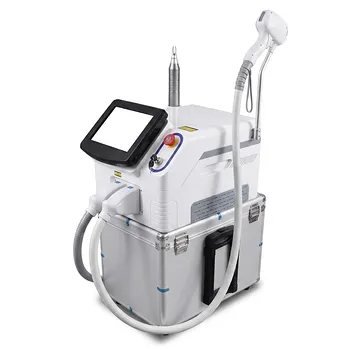
A 694 nm ruby laser removes hair by converting melanin-selective light into follicle-damaging heat. Its red wavelength is strongly absorbed by melanin in the hair shaft and follicle, creating thermal injury that can damage the bulb, germ cells, and surrounding follicular structures. Recommended starting parameters are typically 1–20 ms pulse duration, 10–40 J/cm² fluence, and a 5–10 mm spot diameter, with final settings adjusted to skin type, hair characteristics, and treatment response.
The ruby laser is most selective when dark, coarse hair is contrasted against very light skin. Its high melanin absorption improves targeting of the follicle but also increases epidermal absorption, so conservative parameter selection, test spots, and appropriate clinical assessment are essential.
How the 694 nm Ruby Laser Targets Hair
Melanin is the primary chromophore
At 694 nm, ruby-laser energy is strongly absorbed by melanin. The hair shaft and follicular structures contain substantially more melanin than the surrounding dermis, particularly when the hair is dark.
After absorption, the optical energy is converted into heat. That heat damages the hair shaft, bulb, germ cells, and nearby follicular epithelium, reducing the follicle’s ability to produce new hair.
Selective photothermolysis creates the treatment effect
Selective photothermolysis requires three conditions:
- A wavelength preferentially absorbed by the target.
- Sufficient fluence to produce therapeutic thermal injury.
- A pulse duration that limits unnecessary heat transfer to surrounding tissue.
For ruby-laser hair removal, the target is the melanin-containing hair follicle, while the desired outcome is greater follicular heating than epidermal heating.
Heat can extend beyond the initial absorption site
The hair shaft may act as the initial absorber, but follicular destruction also depends on heat spreading from the shaft into adjacent follicular structures.
This extended effect is sometimes described using thermal damage time, or TDT. The pulse must allow enough heat diffusion to injure relevant follicular cells without producing excessive damage in the surrounding dermis.
Why Patient and Hair Selection Matter
The strongest indication is dark hair on light skin
Ruby lasers are most effective when there is strong contrast between dark hair and lightly pigmented skin. Dark hair absorbs the wavelength efficiently, while lower epidermal melanin reduces competing absorption at the skin surface.
This improves the ratio of follicular heating to epidermal heating and generally provides a wider safety margin.
Darker skin increases epidermal risk
The 694 nm wavelength is highly absorbed by epidermal melanin as well as hair melanin. In patients with more pigmented skin, a significant portion of the energy may be absorbed before reaching deeper follicles.
This can reduce effective follicular penetration and increase the risk of pigmentary abnormalities or epidermal injury. Ruby-laser treatment is therefore generally restricted to carefully selected patients with very light skin and low epidermal melanin.
Hair pigmentation affects response
Because melanin is the target, dark, pigmented hair is more suitable than light, gray, or poorly pigmented hair. The treatment is less predictable when the follicle contains insufficient melanin to absorb and convert the laser energy into heat.
Recommended Operational Parameters
The following ranges describe the parameters supplied in the reference material. They are not fixed prescriptions; clinical settings must be individualized and applied by trained practitioners.
Pulse duration: approximately 1–20 ms
A pulse duration of roughly 1 to 20 milliseconds allows the follicle to heat sufficiently while limiting excessive heat diffusion into the epidermis.
A representative value may be around 10 ms, but the correct duration depends on hair thickness, skin pigmentation, follicular depth, and the selected fluence.
The pulse should be long enough to produce the intended follicular thermal injury, while avoiding unnecessary epidermal heating.
Fluence: approximately 10–40 J/cm²
Recommended fluence generally falls within 10–40 J/cm², adjusted according to skin type and treatment response.
Higher fluence increases the thermal dose delivered to the follicle but also increases the risk of epidermal injury, particularly when epidermal melanin is present. Lower fluence may improve tolerability but may not generate sufficient follicular damage.
A value such as 26 J/cm² may be used as an example configuration, but it should not be treated as a universal setting.
Spot diameter: approximately 5–10 mm
A spot diameter of approximately 5–10 mm is recommended in the reference material.
Larger spots can provide greater effective depth because they reduce the relative influence of lateral light scattering. However, spot size also affects treatment coverage, energy distribution, and the total thermal load delivered to the skin.
Example parameter relationship
A practical conceptual configuration might use:
- Wavelength: 694 nm
- Pulse duration: approximately 10 ms
- Fluence: approximately 26 J/cm²
- Spot diameter: within the 5–10 mm range
These values illustrate how wavelength, pulse duration, fluence, and spot size work together. They do not replace device-specific protocols or patient-specific adjustment.
Understanding the Trade-offs
High melanin absorption improves targeting but reduces penetration
The ruby wavelength’s major strength is also its principal limitation. Strong melanin absorption makes it effective for dark hair, but it also causes more energy to be absorbed by epidermal melanin.
Consequently, the wavelength is not simply “deep penetrating” in every patient. Its effective reach can be limited when superficial skin pigmentation absorbs too much of the incident energy.
More energy is not automatically better
Increasing fluence may increase follicular injury, but it also raises the probability of epidermal damage. The goal is not maximum energy; it is adequate follicular heating with acceptable epidermal exposure.
Treatment should therefore be optimized around the patient’s response and safety margin rather than using the highest available setting.
Pulse duration must balance heating and confinement
Very short pulses can limit heat diffusion but may not deliver the desired follicular thermal effect. Excessively long pulses can allow heat to spread into surrounding tissue and increase unwanted injury.
The appropriate pulse duration must balance follicular heating, heat diffusion, hair diameter, and epidermal protection.
Common parameter errors
Several mistakes can compromise treatment:
- Applying a standard fluence without accounting for skin pigmentation.
- Assuming that strong melanin absorption guarantees deep follicular delivery.
- Increasing energy when the actual problem is inadequate patient or hair selection.
- Ignoring the interaction between pulse duration, spot size, and fluence.
- Treating without a conservative test area or adequate observation of the skin response.
How to Apply This to a Treatment Plan
Parameter selection should begin with the patient’s skin pigmentation and hair characteristics, then be refined through cautious clinical assessment.
- If your primary focus is maximum follicular selectivity: Use the 694 nm wavelength for carefully selected patients with very light skin and dark, pigmented hair, because the contrast improves preferential absorption by the follicle.
- If your primary focus is epidermal safety: Use conservative fluence and pulse-duration choices within the stated ranges, perform a test spot, and monitor the response before broader treatment.
- If your primary focus is effective follicular heating: Consider pulse durations around several milliseconds, fluences within approximately 10–40 J/cm², and spot sizes of about 5–10 mm while accounting for hair thickness and follicular depth.
- If your primary focus is treating darker or more heavily pigmented skin: Recognize that the ruby wavelength carries increased epidermal absorption and may offer a narrower safety margin; treatment suitability requires specialist evaluation rather than automatic parameter escalation.
Effective ruby-laser hair removal depends on matching melanin-selective wavelength, thermal timing, fluence, spot size, and patient selection—not on any single parameter alone.
Summary Table:
| Parameter | Recommended Range | Notes |
|---|---|---|
| Wavelength | 694 nm | Strongly absorbed by melanin; best for dark hair on light skin. |
| Pulse Duration | 1–20 ms | Balance follicular heating and epidermal protection. |
| Fluence | 10–40 J/cm² | Adjust based on skin type and response; start low. |
| Spot Diameter | 5–10 mm | Larger spots improve depth but affect coverage. |
| Skin Type | Light skin (low epidermal melanin) | High contrast reduces epidermal risk. |
| Hair Type | Dark, pigmented hair | Higher melanin content ensures effective absorption. |
Unlock the full potential of ruby laser hair removal for your clinic. BELIS offers professional-grade aesthetic equipment, including advanced laser systems designed for precision and safety. Our ruby laser systems are trusted by clinics and premium salons worldwide. Contact us today to learn how BELIS can elevate your hair removal treatments with reliable, high-performance devices. Contact us now for a personalized consultation and discover exclusive benefits for your practice.
Related Products
- 808nm Diode Laser Hair Removal Machine 755+808+1064nm Mixed Wavelength Professional Equipment
- Diode Tri Laser Hair Removal Machine for Clinic Use
- Tri Laser Diode Hair Removal Machine Professional Beauty Equipment
- 808nm Diode Laser Hair Removal Machine and Equipment with Picolaser Arm
- Clinic Diode Laser Hair Removal Machine with SHR and Trilaser Technology
People Also Ask
- How can aesthetic practitioners prevent side effects like paradoxical hair regrowth and thermal burns when performing diode laser hair removal on dark skin? Master safe protocols for Fitzpatrick IV–VI skin.
- How do broad-spectrum noncoherent light sources compare to single-wavelength diode lasers in aesthetic hair removal applications? Find the best fit for your clinic.
- Why is monitoring the revenue rate per hour per physician essential when deciding to invest in high-throughput aesthetic technology like diode hair removal lasers or multi-applicator body sculpting machines? Optimize your practice's profitability
- What are the primary differences in mechanism and pigment dependency between standard laser hair removal devices (Alexandrite, Diode, Nd:YAG) and photosensitizer-assisted light therapies? Discover expert insights and tailored solutions
- How do practitioners select between 755nm Alexandrite, 810nm Diode, and 1064nm Nd:YAG laser wavelengths based on Fitzpatrick skin typing and hair characteristics? Achieve Safe, Effective Hair Removal for Every Skin Type