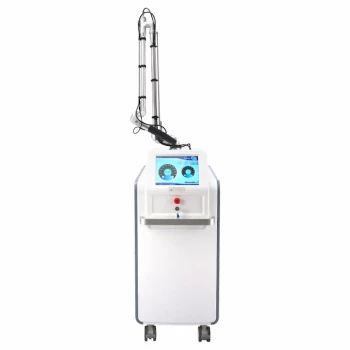
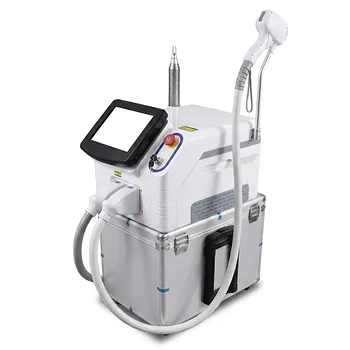
Picosecond and subnanosecond lasers shatter pigment more effectively because they deliver energy in pulses much shorter than traditional Q-switched Nd:YAG systems. Typical picosecond systems use approximately 450–750 ps pulses, compared with roughly 5–10 ns for conventional Q-switched Nd:YAG lasers. Under comparable treatment conditions, this shorter pulse duration produces substantially higher peak tensile stress and stronger photoacoustic shock waves, fragmenting melanosomes and tattoo particles into finer pieces while limiting heat diffusion into surrounding tissue.
The central advantage is mechanical precision: shorter pulses concentrate energy into a more intense, localized stress wave, producing finer pigment fragmentation with less collateral thermal injury than longer nanosecond pulses.
Why Pulse Duration Determines Pigment Fragmentation
Shorter Pulses Concentrate Energy
A laser pulse deposits energy over its pulse width. When the same general amount of energy is delivered in less time, the instantaneous power and resulting mechanical stress increase significantly.
The primary reference describes peak tensile stress as inversely proportional to the square of pulse duration. Therefore, reducing a pulse from the nanosecond range to the subnanosecond range can produce a dramatic increase in stress, potentially approaching 100 times greater stress when the pulse duration is reduced by a factor of ten.
This relationship depends on comparable fluence, spot size, wavelength, and tissue conditions. It should be understood as a physical scaling principle, not as a guaranteed clinical result for every device or treatment setting.
Pulse Duration Approaches the Target’s Relaxation Time
Melanosomes and small tattoo pigment particles have very short stress or thermal relaxation times. The supplementary references place the stress relaxation time of melanosomes at approximately 300 ps.
Picosecond pulses in the 450–750 ps range are closer to this timescale than 5–10 ns pulses. Energy is therefore deposited before the target can fully dissipate the induced stress, favoring rapid expansion, compression, and mechanical disruption.
How Photoacoustic Shattering Works
Stress Waves Break the Pigment Apart
The laser energy is absorbed by the pigment, producing a rapid thermoelastic expansion. This expansion launches a pressure or shock wave through the target particle and nearby tissue.
With picosecond or subnanosecond pulses, the pressure rises rapidly enough to generate intense photomechanical and photoacoustic forces. These forces fracture the pigment into smaller fragments rather than relying primarily on prolonged heating.
Finer Fragments Improve Biological Clearance
Once pigment has been fragmented, macrophages and other clearance mechanisms can transport and metabolize the debris more efficiently.
The difference is similar to breaking a solid object into gravel versus dust. Both are fragmented, but the smaller particles generally present more accessible material for cellular uptake and removal.
Shock Waves Remain More Localized
A shorter pulse also limits the time available for the generated stress and heat to spread outward. The shock wave remains spatially confined around the target more effectively than with a longer pulse.
This localization helps focus the treatment effect on melanosomes, tattoo ink, or other pigment particles while reducing unnecessary mechanical and thermal exposure to adjacent dermal structures.
Why This Can Reduce Thermal Side Effects
Less Heat Diffusion
Traditional Q-switched Nd:YAG lasers commonly use pulses around 5–10 ns. These pulses are already short and can produce photoacoustic effects, but they also allow more time for heat to accumulate and diffuse through surrounding tissue.
Picosecond systems shift the balance further toward rapid photomechanical disruption. Because the target is disrupted more quickly, less energy needs to be converted into unwanted heat in the surrounding tissue.
Lower Risk of Pigmentary Complications
Reduced collateral heating can lower the risk of thermal side effects, including post-inflammatory hyperpigmentation and hypopigmentation. This may be particularly relevant when treating patients or conditions prone to pigmentary change.
However, risk is not eliminated. Fluence, wavelength, skin type, treatment interval, inflammation, and operator technique remain important determinants of safety.
Potentially Improved Treatment Tolerance
The more localized mechanical interaction may also reduce treatment discomfort compared with treatments that generate greater nonspecific thermal injury. Clinical comfort still varies according to treatment area, energy settings, cooling, and individual sensitivity.
How Picosecond Systems Compare With Q-Switched Nd:YAG
Q-Switched Nd:YAG Lasers
Q-switched Nd:YAG lasers deliver nanosecond pulses with high peak power. They can fragment pigment through a combination of photothermal and photoacoustic mechanisms.
They remain effective and established systems, but their longer pulse duration generally produces less concentrated mechanical stress than a picosecond pulse under otherwise comparable conditions.
Picosecond and Subnanosecond Lasers
Picosecond systems reduce pulse duration by more than an order of magnitude relative to many traditional Q-switched systems. This increases peak power and intensifies the photoacoustic stress applied to the pigment.
The resulting fragments can be substantially finer, which may improve clearance efficiency for stubborn, dense, or very small pigment particles.
The Clinical Result Depends on More Than Pulse Width
Pulse duration is central, but it is not the only variable. Wavelength determines absorption, fluence determines delivered energy per unit area, spot size affects penetration and peak irradiance, and repetition rate influences treatment speed and heat accumulation.
A well-matched Q-switched treatment can outperform an improperly selected picosecond treatment. Device selection must therefore account for the pigment type, depth, skin characteristics, and treatment objective.
Understanding the Trade-Offs
Shorter Pulses Do Not Guarantee Faster Clearance
Finer fragmentation can improve biological removal, but pigment clearance still depends on macrophage activity, circulation, lymphatic transport, pigment depth, and the patient’s inflammatory response.
Multiple sessions may remain necessary, especially for dense tattoos, deeply located pigment, or conditions with ongoing pigment production.
Settings Must Be Carefully Controlled
The high peak stress of picosecond systems increases the importance of appropriate fluence and pulse selection. Excessive energy can still cause unwanted epidermal or dermal injury, even when the pulse is extremely short.
Treatment should be adjusted to the target rather than assuming that the shortest available pulse is always the safest or most effective option.
Thermal Effects Are Reduced, Not Absent
Picosecond lasers are not purely mechanical devices. Absorbed optical energy can still produce heat, and repeated pulses in the same region can increase thermal loading.
Appropriate spacing, cooling, wavelength selection, and conservative escalation remain necessary to manage adverse effects.
Making the Right Choice for Your Goal
The practical choice should be based on the desired pigment target and the need to balance fragmentation, clearance, safety, and treatment efficiency.
- If your primary focus is finer pigment fragmentation: Choose a picosecond or subnanosecond system capable of generating intense, localized photoacoustic stress in the target.
- If your primary focus is minimizing collateral thermal injury: Favor appropriately selected short-pulse treatment parameters, while recognizing that wavelength, fluence, cooling, and technique remain equally important.
- If your primary focus is treating resistant or minute pigment particles: Consider picosecond technology because its finer mechanical fragmentation may improve macrophage-mediated clearance.
- If your primary focus is predictable treatment planning: Evaluate the complete device specification and clinical protocol rather than pulse duration alone.
Shorter pulses improve pigment shattering by converting laser energy into more concentrated, localized mechanical stress, giving clinicians a more precise way to fragment pigment while controlling thermal damage.
Summary Table:
| Parameter | Picosecond/Subnanosecond | Traditional Q-Switched Nd:YAG |
|---|---|---|
| Pulse Duration | 450–750 ps (typical) | 5–10 ns (typical) |
| Peak Tensile Stress | Higher (inversely proportional to square of pulse duration) | Lower |
| Primary Mechanism | Photoacoustic (mechanical) disruption | Photothermal + photoacoustic |
| Fragment Size | Finer | Coarser |
| Thermal Diffusion | Limited | More pronounced |
| Risk of Pigmentary Side Effects | Lower (potentially) | Higher (potentially) |
| Clinical Focus | Stubborn/dense pigment, fine fragmentation | Broad range of pigmentary conditions |
Unlock the Potential of Picosecond Lasers for Your Clinic
At BELIS, we specialize in professional-grade aesthetic equipment exclusively for clinics and premium salons. Our advanced laser systems include picosecond lasers that deliver superior pigment shattering with minimal thermal damage, ensuring faster clearance and enhanced patient satisfaction. Explore our range of laser solutions—from Diode and Alexandrite to Nd:YAG and Pico—to find the perfect fit for your practice. Our experts provide comprehensive training and support to maximize your investment. Contact us today to discover how BELIS can elevate your treatments and grow your business. Get in Touch!
Related Products
- Pico Laser Tattoo Removal Machine Picosure Picosecond Laser Machine
- 808nm Diode Laser Hair Removal Machine and Equipment with Picolaser Arm
People Also Ask
- How does a laser tattoo removal machine work? Shattering Ink with Precision Light
- Why is the precise adjustment of energy density, or fluence, critical during picosecond laser tattoo removal procedures?
- How does the pulse duration of a laser system influence the efficacy of tattoo ink clearance? Master Picosecond Tech
- What role does picosecond laser equipment play in tattoo removal? Faster Results & Advanced Precision
- What are the technical advantages of using Pico Laser or Nd:YAG Laser systems? Achieve Faster, Safer Tattoo Removal