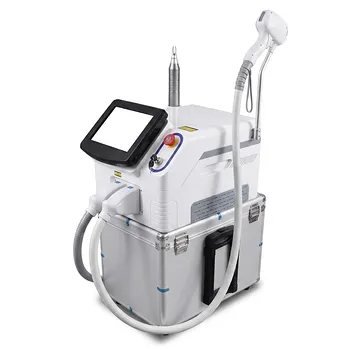
Diode and CO2 lasers serve different tissue objectives. CO2 systems are generally superior for precise, superficial soft-tissue resection because their 10,600 nm energy is absorbed at the tissue surface and vaporizes tissue layer by layer. Diode systems, delivered through a fiber in contact mode, remove somewhat less tissue but transfer more heat into the submucosa, making them better suited to interstitial coagulation, collagen contraction, and tissue tightening.
CO2 lasers primarily reshape tissue by controlled surface vaporization; diode lasers primarily reinforce tissue through deeper thermal coagulation, wound-edge contraction, and submucosal scar formation. The appropriate choice depends on whether the procedure requires maximum precision at the surface or controlled tightening beneath it.
How Soft-Tissue Resection Differs
CO2 Laser: Precise Superficial Vaporization
CO2 lasers operate at approximately 10,600 nm, a wavelength strongly absorbed by water. This produces rapid, layer-by-layer vaporization with a relatively shallow zone of thermal injury.
The operator can directly see the tissue response as the beam removes tissue. Free-beam handpieces and scanner-assisted delivery support precise incisions, sculpting, and superficial volume reduction.
Diode Laser: Contact-Based Tissue Removal
Diode systems commonly operate in the 805–980 nm range, including 810 nm and 940 nm systems. Their energy is typically delivered through a flexible optical fiber in contact mode.
This provides tactile feedback during cutting and allows targeted energy delivery within confined anatomical spaces. However, diode systems generally produce less purely superficial resection than CO2 systems and rely more heavily on thermal effects within the tissue.
The Practical Difference
CO2 treatment is analogous to removing tissue with a highly controlled surface tool. Diode treatment combines tissue removal with heating, coagulation, and contraction around the fiber path.
This makes CO2 more predictable when the primary objective is visible surface resection. Diode systems are more versatile when resection must be combined with hemostasis or deeper tissue reinforcement.
How Interstitial Coagulation Differs
Diode Laser: Deep Submucosal Coagulation
Diode energy can penetrate beyond the immediate surface and create a deeper thermal coagulation zone. When applied interstitially, the fiber deposits energy within the submucosal tissue rather than only across the exposed surface.
This is particularly useful for coagulating tissue from within, sealing small vessels, and reducing the volume of blood-rich or lax tissue. Lower power settings, such as approximately 3–5 W in the referenced application, can produce controlled thermal effects without requiring aggressive surface ablation.
CO2 Laser: Shallow Thermal Control
CO2 energy is absorbed very close to the surface, producing precise vaporization and a relatively shallow coagulation zone. It can provide reliable hemostasis for small vessels, but it is less naturally suited to delivering energy deep into intact submucosal tissue.
Its strength is controlling the tissue that is visibly being removed. Its limitation for interstitial treatment is that the beam does not readily travel through tissue to create a deep coagulation volume.
Why Delivery Method Matters
CO2 systems generally use free-beam or scanner-assisted delivery, while diode systems use flexible fibers. The fiber allows a diode laser to reach and treat tissue through a narrow access path and to apply energy directly within the target layer.
The same contact delivery that improves access also creates a deeper thermal field. Consequently, diode procedures require careful control of power, exposure duration, and spacing to avoid unnecessary injury to adjacent tissue.
How Tissue Tightening Occurs
Diode Laser: Collagen Shrinkage and Scar Formation
Diode-induced heating causes controlled contraction of collagen-containing tissue. As the treated tissue heals, the resulting remodeling and submucosal scar formation can stiffen previously lax structures.
The tightening effect therefore has two stages: immediate wound-edge and collagen contraction, followed by gradual tissue reinforcement during healing over several weeks.
CO2 Laser: Tightening Through Surface Resurfacing
CO2 systems can also affect tissue firmness by removing superficial layers and inducing a healing response. Their primary mechanism, however, is surface vaporization and controlled thermal injury rather than direct interstitial heating.
When tightening depends on deeper collagen contraction within a lax submucosal structure, a diode system may provide a more direct mechanism. When the goal is superficial resurfacing, contouring, or precise excision, CO2 treatment may be more appropriate.
Thermal Selectivity Is Different
CO2 selectivity comes largely from the immediate absorption of its energy at the tissue surface. The operator controls the depth and extent of injury through beam movement, spot size, power, and exposure.
Diode systems distribute thermal energy through optical absorption and fiber contact. Their deeper coagulation profile can support tightening, but it also makes energy management more important because thermal effects may extend beyond the visibly treated surface.
Understanding the Trade-offs
Precision Versus Reinforcement
CO2 lasers generally offer greater precision for superficial tissue removal and a more limited thermal footprint beneath the treatment plane. Diode lasers generally offer stronger tissue reinforcement because they produce deeper coagulation and contraction.
The choice is therefore not simply about which laser is more powerful. It is about whether the procedure prioritizes controlled excision, deep coagulation, or a combination of both.
Hemostasis Versus Thermal Spread
Both systems can support hemostasis, particularly for small vessels. Diode systems may provide more robust coagulation in vascular or blood-rich tissue because their deeper thermal effect reaches vessels beneath the surface.
That advantage carries a corresponding risk of greater collateral heating and potentially prolonged healing if exposure is excessive. Pulsed or chopped delivery with short exposure intervals can help limit heat transfer to adjacent structures.
Healing Profile
CO2 procedures often produce a comparatively shallow wound and can offer a clearly defined tissue response. Diode contact procedures create a deeper thermal coagulation zone, which may extend healing compared with a purely superficial CO2 treatment.
Actual healing depends on wavelength, power, pulse structure, tissue composition, fiber technique, and the treated anatomy. Penetration values should therefore be treated as approximate rather than fixed properties of every system.
Operator Dependence
CO2 treatment requires precise manual control of beam movement, spot size, and power because the tissue is vaporized directly in front of the operator. Diode treatment requires equally careful control of fiber placement, contact pressure, exposure time, and thermal spacing.
Neither system eliminates the need for technique. CO2 errors tend to appear as excessive or uneven surface removal, while diode errors may present as excessive deep coagulation or delayed healing.
Making the Right Choice for Your Goal
The best system is the one whose dominant tissue effect matches the intended clinical endpoint.
- If your primary focus is precise superficial resection: Choose a CO2 system when controlled, layer-by-layer vaporization and minimal deep thermal injury are the main objectives.
- If your primary focus is interstitial coagulation: Choose a diode system when energy must be delivered through a fiber into submucosal tissue for targeted coagulation and vessel sealing.
- If your primary focus is tissue tightening: Favor diode treatment when collagen contraction, wound-edge retraction, and submucosal scar formation are central to the desired result.
- If your primary focus is combined volume reduction and hemostasis: Consider a diode system when deeper coagulation and controlled thermal shrinkage are beneficial, while carefully limiting exposure to protect adjacent tissue.
In short, CO2 lasers excel at seeing and removing superficial tissue, while diode lasers excel at heating, coagulating, and tightening tissue from within.
Summary Table:
| Feature | Diode Laser | CO2 Laser |
|---|---|---|
| Wavelength | 805-980 nm | 10,600 nm |
| Tissue Absorption | Absorbed by hemoglobin/melanin, deeper penetration | Strongly absorbed by water, superficial absorption |
| Resection Precision | Contact mode, less precise for superficial excision | Free-beam, precise layer-by-layer vaporization |
| Coagulation Depth | Deep interstitial coagulation | Shallow coagulation zone |
| Tissue Tightening | Direct collagen contraction and scar formation | Indirect via surface resurfacing |
| Best For | Interstitial coagulation, hemostasis, tissue tightening | Superficial resection, precise excision, sculpting |
Ready to elevate your aesthetic practice with the right laser technology? At BELIS, we specialize in professional-grade medical aesthetic equipment for clinics and premium salons. Our advanced portfolio includes diode and CO2 laser systems, alongside a full spectrum of solutions like IPL, PDT, HIFU, and more. Whether you're a clinic seeking precision tools or a distributor looking for OEM/ODM support and reliable supply, we have the expertise and certifications to meet your needs. Contact us today to discuss your requirements and discover how our cutting-edge devices can enhance your offerings and drive growth — contact us now.
Related Products
- Diode Laser SHR Trilaser Hair Removal Machine for Clinic Use
- Diode Tri Laser Hair Removal Machine for Clinic Use
- Clinic Diode Laser Hair Removal Machine with SHR and Trilaser Technology
- Trilaser Diode Hair Removal Machine for Beauty Clinic Use
- 808nm Diode Laser Hair Removal Machine 755+808+1064nm Mixed Wavelength Professional Equipment
People Also Ask
- What is the working mechanism of professional-grade Diode laser equipment? Master the Physics of Selective Photothermolysis
- What are the characteristics of the Diode laser for hair removal? The Gold Standard for Deep Efficacy and Skin Safety
- What are the technical advantages of using industrial-grade Diode lasers? Superior Precision for Professional Clinics
- What advancements have occurred in laser hair removal machine technology? Trends Shaping Modern Aesthetic Clinics
- How long does a single laser hair removal session take? Fast & Effective Treatments for Your Busy Schedule