
Yes, diode laser hair removal can lead to permanent hair reduction, but it is critical to understand that this is achieved through a series of treatments, not a single session. The process is designed to permanently damage hair follicles, but its effectiveness is tied directly to the natural growth cycle of your hair.
The term "permanent" in laser hair removal refers to a significant and stable reduction in hair over time. It is achieved by targeting and damaging hair follicles during their active growth phase, which requires multiple sessions to be effective across all hairs in a given area.
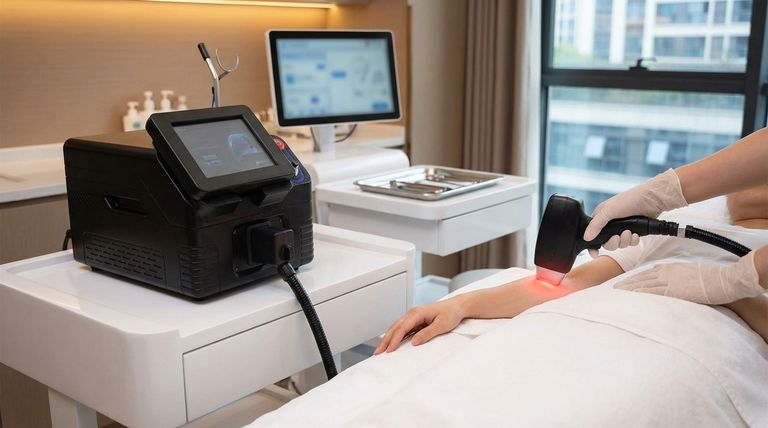
How Diode Lasers Achieve Hair Reduction
To understand the results, you must first understand the mechanism. The process isn't just about heat; it's about precision targeting based on biology.
The Principle of Selective Photothermolysis
Diode lasers work by emitting a specific wavelength of light that is absorbed by the melanin (pigment) in your hair.
This light energy converts into heat, which travels down the hair shaft to the follicle. The heat then damages the key structures within the follicle responsible for hair growth.
The Critical Role of Hair Growth Cycles
Hair does not grow continuously. Each follicle cycles through three phases: Anagen (active growth), Catagen (transition), and Telogen (resting).
A diode laser is only effective during the Anagen phase. This is because the hair must be actively connected to the follicle's base for the heat to transfer and cause damage effectively.
Since only a fraction of your hair is in the Anagen phase at any given time, a single treatment can only address that specific group of hairs.
Why "Permanent Reduction" is the Accurate Term
The FDA uses the term "permanent hair reduction" to describe the outcome. This means a significant, long-term, and stable reduction in the number of hairs that regrow after a full course of treatment.
It does not promise the absolute elimination of every single hair forever. Some very fine or lighter hairs may remain, and some follicles may eventually recover to produce new hair.
Understanding the Treatment Process and Expectations
Achieving a permanent result is a strategic process that requires patience and adherence to a prescribed schedule.
The Necessity of Multiple Sessions
Because of the hair growth cycles, treatments must be spaced several weeks apart. This timing is designed to target the next wave of follicles as they enter the active Anagen phase.
Skipping sessions or extending the time between them can compromise the final outcome by missing the ideal window for treatment.
Customization is Key
Your provider will customize the treatment plan based on your specific skin tone, hair color, and hair thickness.
The ideal scenario for diode lasers is dark, coarse hair on fair skin. This contrast allows the laser to target the hair's melanin with maximum efficiency while minimally affecting the surrounding skin.
The Possibility of Future Touch-Ups
Even after a successful course of treatments, some new hair growth can occur over the years. This can be caused by hormonal shifts (like pregnancy or menopause) or simply dormant follicles becoming active.
For this reason, many people opt for a single maintenance or "touch-up" session every year or two to maintain their results.
Making the Right Choice for Your Goal
Your approach should be guided by your expectations and your willingness to commit to the full process.
- If your primary focus is maximum, long-term hair removal: Commit to the complete series of treatments recommended by your practitioner, ensuring sessions are properly timed to target every growth cycle.
- If your primary focus is significant hair reduction but not total removal: Even a partial course of treatments can result in finer, lighter, and sparser hair, but the results will be less permanent.
- If you have very light, red, or gray hair: A diode laser is likely not the most effective option, as these hair colors lack the melanin needed for the laser to work.
Understanding the science behind the process empowers you to set realistic goals and achieve the best possible long-term results.
Summary Table:
| Key Factor | Impact on Results |
|---|---|
| Hair Growth Cycles | Multiple sessions needed to target follicles in the active growth (Anagen) phase. |
| Ideal Candidate | Best for dark, coarse hair on fair skin for maximum effectiveness. |
| Realistic Outcome | FDA-defined "permanent hair reduction," not 100% elimination of all hair. |
| Maintenance | Occasional touch-up sessions may be needed due to hormonal changes. |
Ready to offer your clients effective, long-term hair removal solutions?
BELIS specializes in professional medical aesthetic equipment, including advanced diode laser systems designed for the rigorous demands of medical aesthetics clinics and premium beauty salons. Our technology ensures precise, safe, and efficient treatments that enhance client satisfaction and grow your business.
Contact our experts today to discover the right diode laser equipment for your practice and learn how we can support your success.
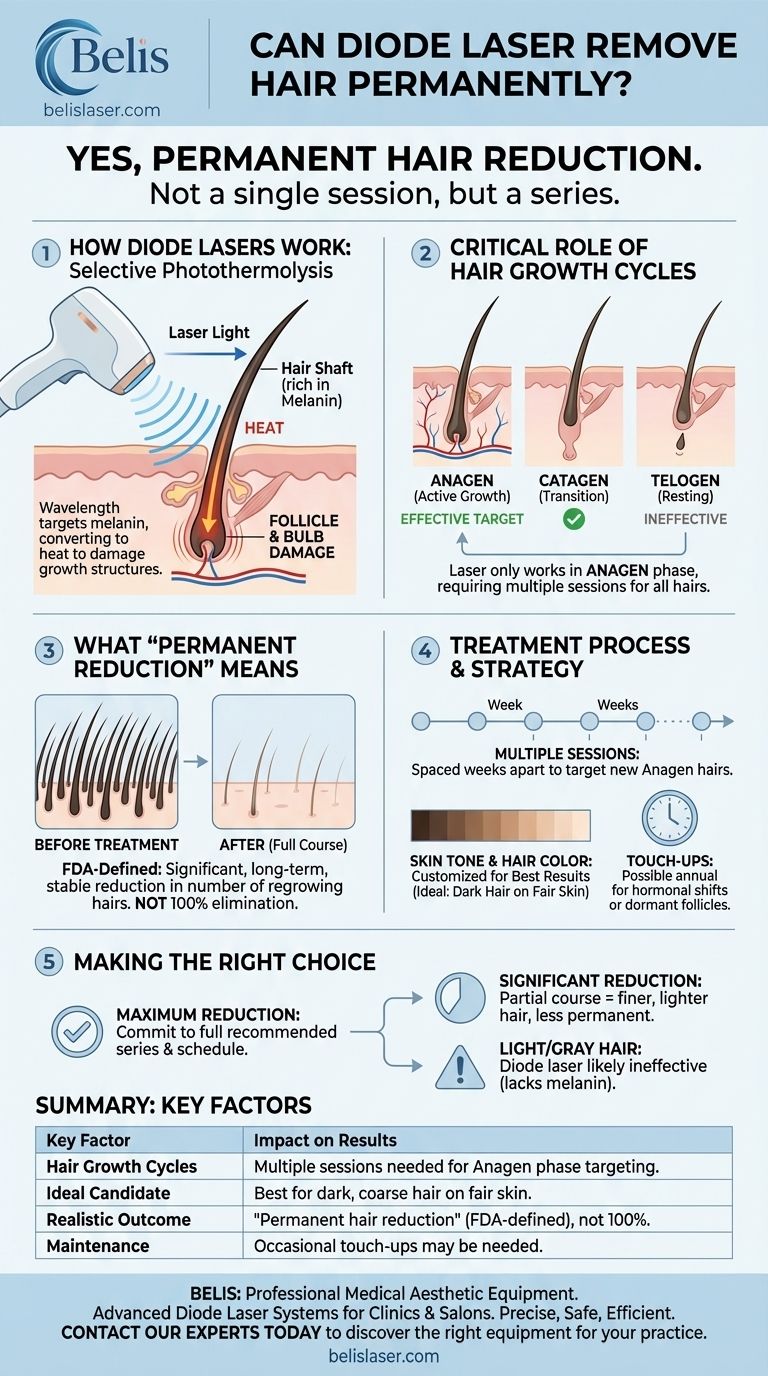
Visual Guide
Related Products
- Clinic Diode Laser Hair Removal Machine with SHR and Trilaser Technology
- Diode Tri Laser Hair Removal Machine for Clinic Use
- Diode Laser SHR Trilaser Hair Removal Machine for Clinic Use
- Trilaser Diode Hair Removal Machine for Beauty Clinic Use
- Clinic Use IPL SHR ND YAG Laser Hair Removal RF Skin Tightening Machine
People Also Ask
- How can aesthetic practitioners prevent side effects like paradoxical hair regrowth and thermal burns when performing diode laser hair removal on dark skin? Master safe protocols for Fitzpatrick IV–VI skin.
- How do broad-spectrum noncoherent light sources compare to single-wavelength diode lasers in aesthetic hair removal applications? Find the best fit for your clinic.
- What are the advantages of the Constant Motion Technique? Elevate Your Clinic's Laser Hair Removal Results
- Why can traditional high-energy pulse (HR) modes lead to adverse skin reactions? Understanding Thermal Injury Risks
- Why is a 40-ms pulse width critical for Fitzpatrick skin types III-V? The Key to Safe & Effective Laser Hair Removal












