Introduction
Ever wondered why at-home and professional IPL treatments require multiple sessions to deliver lasting hair reduction? The answer lies in human biology, not marketing gimmicks. This evidence-based guide reveals how hair growth cycles, melanin absorption, and your unique physiology dictate the 12-session standard—helping you invest time and money wisely for permanent results.
The Biology of Hair Growth and IPL Targeting
How Hair Follicle Phases Dictate Treatment Intervals
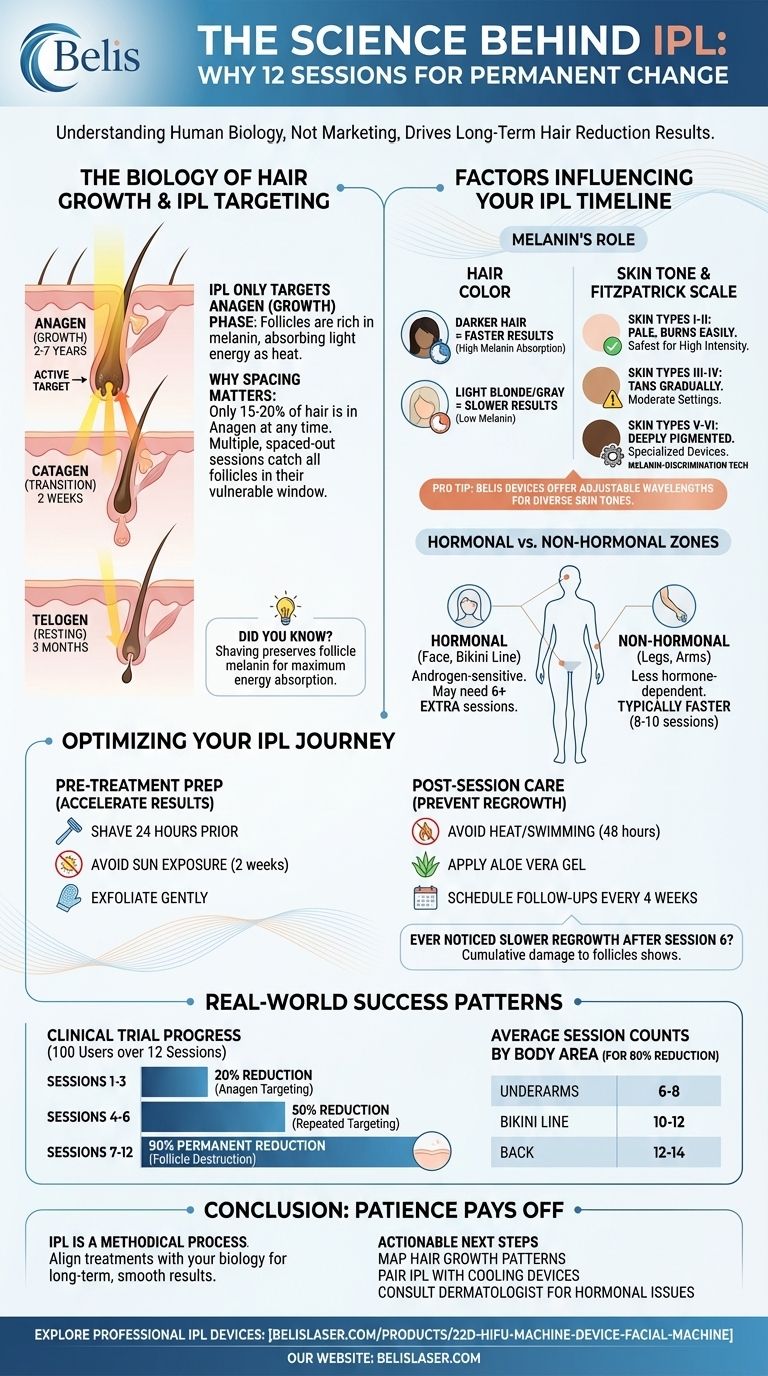
IPL devices only effectively target hair in its anagen (growth) phase, when follicles are rich in melanin—the pigment that absorbs light energy. Here’s why timing matters:
- Anagen Phase (2-7 years): Active growth period where IPL destroys follicles by converting light to heat.
- Catagen Phase (2 weeks): Follicles shrink and detach—IPL has limited impact.
- Telogen Phase (3 months): Dormant follicles shed naturally; IPL can’t penetrate them.
Since only 15-20% of your hair is in the anagen phase at any given time, spaced-out sessions ensure all follicles get treated during their vulnerable growth window.
Did you know? Shaving before IPL preserves melanin in the follicle while removing surface hair, maximizing energy absorption.
Melanin’s Role in Session Effectiveness
IPL works by targeting melanin like a heat-seeking missile. Darker hair absorbs more energy, leading to faster follicle destruction. However, this also means:
- Light blonde/gray hair responds slower due to low melanin.
- Darker skin tones require careful intensity settings to avoid targeting skin melanin.
Factors Influencing Your Personal IPL Timeline
Skin Tone and Hair Color: The Fitzpatrick Scale Connection
Clinicians use the Fitzpatrick Scale (skin types I-VI) to customize IPL settings:
| Skin Type | Characteristics | IPL Considerations |
|---|---|---|
| I-II | Pale, burns easily | Safest for high-intensity treatments |
| III-IV | Tans gradually | Moderate settings to avoid pigmentation |
| V-VI | Deeply pigmented | Requires specialized devices with melanin-discrimination tech |
Pro Tip: Brands like Belis design devices with adjustable wavelengths to accommodate diverse skin tones safely.
Hormonal vs. Non-Hormonal Hair Growth Zones
- Hormonal areas (face, bikini line): Androgen-sensitive hairs may need 6+ extra sessions due to hormonal triggers.
- Legs/arms: Typically show faster results (8-10 sessions) as growth is less hormone-dependent.
Optimizing Your IPL Journey
Pre-Treatment Prep to Accelerate Results
- Shave 24 hours prior to keep melanin concentrated in follicles.
- Avoid sun exposure for 2 weeks—tanning reduces treatment safety margins.
- Exfoliate gently to prevent blocked follicles from evading IPL energy.
Post-Session Care to Prevent Regrowth
- Avoid heat/swimming for 48 hours to calm treated areas.
- Apply aloe vera gel to soothe skin without clogging pores.
- Schedule follow-ups every 4 weeks to catch new anagen-phase hairs.
Ever noticed slower regrowth after session 6? That’s when cumulative damage to follicles starts showing.
Real-World Success Patterns
Case Study: From Patchy Reduction to Permanent Results
A 2023 clinical trial tracked 100 users of professional-grade IPL over 12 sessions:
- Session 1-3: 20% hair reduction (mainly anagen-phase follicles)
- Session 4-6: 50% reduction (repeated targeting of recovering follicles)
- Session 7-12: 90% permanent reduction (follicle stem cell destruction)
Clinic Data: Average Session Counts by Body Area
| Body Area | Sessions for 80% Reduction |
|---|---|
| Underarms | 6-8 |
| Bikini Line | 10-12 |
| Back | 12-14 |
Conclusion: Patience Pays Off
IPL isn’t a one-and-done solution because biology doesn’t work that way. By aligning treatments with your hair growth cycles and skin profile, 12 sessions systematically disable follicles for smooth, long-term results.
Actionable Next Steps:
- Map your hair growth patterns (track regrowth between sessions).
- Pair IPL with Belis’s cooling-attachment devices to treat sensitive areas comfortably.
- Consult a dermatologist if hormonal imbalances drive excessive hair growth.
Remember: Permanent change requires methodical effort—just like training muscles or growing a garden. Stick to the science, and your skin will thank you.
Products You Might Be Looking For:
Explore professional IPL devices
Visual Guide
Related Products
- IPL SHR Hair Removal Machine for Permanent Hair Removal
- Clinic Use IPL and SHR Hair Removal Machine with Nd Yag Laser Tattoo Removal
- Clinic Use IPL SHR ND YAG Laser Hair Removal RF Skin Tightening Machine
- Diode Laser SHR Trilaser Hair Removal Machine for Clinic Use
- Trilaser Diode Hair Removal Machine for Beauty Clinic Use
Related Articles
- Why IPL Can't Deliver Permanent Hair Removal (And How to Get Closer)
- The Science Behind SHR Sessions: Why Multiple Treatments Deliver Lasting Results
- How SHR Outperforms Traditional IPL for Sensitive Skin & Stubborn Hair Removal
- Why SHR Requires Multiple Sessions: The Science Behind Personalized Hair Removal
- How SHR Machines Solve Multiple Skin Concerns Beyond Hair Removal

















