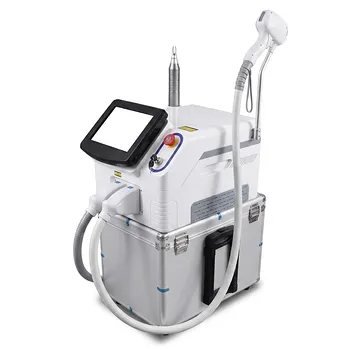
Fractionated nonablative diode lasers—particularly 1927 nm systems—give practices a practical way to improve uneven skin tone with limited downtime and a broad safety range. Low-energy, low-density treatment protocols can produce moderate-to-marked improvements in hyperpigmentation and skin luminance within approximately one to three months, including in patients across Fitzpatrick skin types I–VI. They are best positioned as a non-invasive, entry-level option for mild-to-moderate photodamage, dyschromia, and melasma rather than as a one-treatment resurfacing solution.
Core takeaway: Fractionated 1927 nm diode lasers offer controlled pigment correction while preserving most of the epidermal barrier, making treatment more repeatable and generally more accessible than fully ablative resurfacing. Their main clinical value is the balance between visible tone improvement, limited recovery, and suitability for a broad range of skin types.
Why 1927 nm Treatment Supports Skin Tone Restoration
It targets common causes of uneven tone
A 1927 nm wavelength is strongly absorbed by water in skin tissue. Fractionated delivery creates microscopic treatment zones that can address photodamaged and hyperpigmented areas without removing the entire epidermal surface.
This makes the technology particularly relevant for solar-related dyschromia, diffuse photodamage, and melasma, where patients often seek gradual brightening rather than aggressive resurfacing.
It can improve overall skin luminance
Clinical evaluations of low-energy, low-density protocols report moderate-to-marked improvement in skin brightness and hyperpigmentation over the first one to three months after treatment.
For practices, “skin tone restoration” is therefore not limited to removing isolated pigment spots. The treatment can improve the overall impression of dullness, uneven coloration, and photodamage.
It supports gradual, natural-looking results
Fractionated treatment distributes thermal energy across microscopic areas rather than treating the entire surface at once. The surrounding untreated tissue helps support recovery and enables progressive correction over a series of sessions.
This gradual approach is often preferable for patients who want improvement without the conspicuous peeling, prolonged erythema, or social downtime associated with aggressive resurfacing.
Clinical Benefits for Aesthetic Practices
Broad applicability across Fitzpatrick skin types
The primary reference supports a favorable safety profile across Fitzpatrick skin types I through VI when low-energy, low-density protocols are used appropriately.
This broad applicability can expand the practice’s treatment population. However, darker skin types still require conservative parameter selection, careful skin preparation, and close monitoring because post-inflammatory hyperpigmentation remains possible even with nonablative treatment.
Limited downtime compared with ablative resurfacing
Because nonablative fractional systems preserve much of the stratum corneum, recovery is generally shorter and less disruptive than with fully ablative CO₂ or Er:YAG resurfacing.
Patients may experience transient redness, swelling, warmth, dryness, or temporary darkening and flaking of pigment. Recovery is commonly measured in days rather than the one to two weeks often associated with fully ablative procedures, although the actual duration depends on fluence, density, passes, skin type, and treatment area.
Lower procedural intensity and complication burden
Compared with fully ablative resurfacing, fractional nonablative treatment reduces the extent of epidermal disruption. This generally lowers the risk of complications associated with large-area vaporization, including prolonged erythema, scarring, and significant barrier disruption.
The risk is reduced, not eliminated. Patient selection, sun avoidance, pigment history, antiviral considerations where relevant, and appropriate post-treatment care remain essential.
Repeatable treatment delivery
The controlled and fractional nature of treatment allows practices to adjust energy, density, passes, and treatment intervals according to the patient’s response.
This supports a staged treatment model: begin conservatively, assess pigment response and recovery, then refine subsequent sessions rather than committing to an aggressive single procedure.
A strong entry point for non-invasive rejuvenation
For patients with mild-to-moderate pigment irregularity, a 1927 nm fractional diode laser can serve as an accessible first-line device-based treatment before considering more invasive resurfacing options.
It can also be incorporated into broader rejuvenation plans alongside sun protection, topical pigment management, and other appropriately selected modalities.
What Patients Can Reasonably Expect
Pigment improvement is progressive
Visible improvement may begin during the first several weeks, with clearer changes commonly assessed around one to three months after treatment.
Melasma and photodamage are biologically recurrent conditions. Laser treatment may reduce visible pigment, but it does not remove the underlying tendency toward pigment production or eliminate the need for ongoing photoprotection.
Multiple sessions may be necessary
A single treatment may provide some improvement, but practices should avoid presenting 1927 nm therapy as a guaranteed one-session correction.
A series of treatments is often more realistic, particularly for diffuse photodamage, melasma, or patients seeking simultaneous improvement in texture and fine lines. The exact number and interval should be individualized according to the device, protocol, skin response, and treatment objective.
Texture benefits may accompany tone correction
Fractional thermal injury can stimulate tissue remodeling and may improve fine lines, mild texture irregularity, enlarged pores, and superficial acne scarring.
However, the 1927 nm indication should remain centered on pigment and photodamage. Deeper wrinkles, marked laxity, or severe textural defects generally require different or additional treatment strategies.
How the Technology Works Clinically
Fractional treatment preserves surrounding tissue
The laser creates microscopic treatment zones while leaving intervening tissue untreated. This preserved tissue acts as a biological reserve that supports faster repair than full-field ablative resurfacing.
The result is a controlled compromise: enough thermal injury to initiate pigment clearance and remodeling, but less surface disruption than a fully ablative approach.
Nonablative does not mean risk-free
“Nonablative” means the treatment does not intentionally vaporize or remove broad layers of tissue in the manner of fully ablative resurfacing. It still produces controlled thermal injury and can trigger inflammation.
That distinction matters when counseling patients. The procedure is lower downtime, not zero downtime, and conservative treatment remains especially important for darker or pigment-prone skin.
Understanding the Trade-offs
The results are less dramatic than fully ablative resurfacing
Fully ablative lasers can produce more dramatic resurfacing from a single treatment, but they require substantially more recovery and carry greater procedural risk.
Fractionated nonablative lasers prioritize safety, tolerability, and repeatability. Patients must accept that improvement is usually more gradual and may be less dramatic.
Melasma can recur
Melasma is influenced by ultraviolet exposure, visible light, hormones, inflammation, and individual susceptibility. Even when pigmentation improves, recurrence is possible without consistent broad-spectrum photoprotection and a suitable maintenance plan.
Laser treatment should therefore be presented as one part of a long-term pigment-management strategy, not a permanent cure.
Post-inflammatory hyperpigmentation remains possible
The risk is generally lower than with aggressive ablative resurfacing, particularly when conservative settings are used, but it is not absent.
Practices should be cautious with recent tanning, active dermatitis, uncontrolled acne or inflammation, a history of difficult PIH, and unrealistic expectations about rapid pigment removal.
Low-energy protocols may require patience
Low-energy, low-density protocols improve tolerability and safety but may require more sessions or produce more modest changes per session.
This is an important business and clinical consideration: the practice must communicate the value of a course of treatment, rather than implying that the lowest-risk protocol will deliver maximal correction immediately.
Making the Right Choice for Your Goal
A 1927 nm fractionated nonablative diode laser is most valuable when the practice prioritizes controlled pigment correction, broad patient applicability, and limited recovery.
- If your primary focus is mild-to-moderate hyperpigmentation: Use conservative fractional protocols and set expectations for progressive improvement over approximately one to three months.
- If your primary focus is treating darker skin types: Emphasize low-energy, low-density treatment, strict photoprotection, careful screening, and monitoring for PIH rather than pursuing aggressive single-session correction.
- If your primary focus is melasma: Combine laser treatment with a sustained pigment-management and photoprotection plan because recurrence remains possible.
- If your primary focus is minimal downtime: Position the technology as a lower-disruption alternative to fully ablative resurfacing, while explaining that transient redness, swelling, dryness, or pigment darkening may occur.
- If your primary focus is overall rejuvenation: Use the laser primarily for tone and photodamage, with texture and fine-line improvement treated as potential secondary benefits.
- If your primary focus is predictable clinical operations: Build treatment plans around a series of individualized sessions, standardized photography, and follow-up assessments rather than a single-treatment promise.
For practices seeking non-invasive skin tone restoration, fractionated 1927 nm diode lasers provide a credible balance of pigment improvement, patient inclusivity, manageable downtime, and repeatable treatment control.
Summary Table:
| Benefit | Key Points |
|---|---|
| Targets uneven skin tone | Addresses dyschromia, photodamage, and melasma; improves skin luminance and brightness. |
| Broad skin type applicability | Safe for Fitzpatrick types I–VI with conservative protocols; monitor for PIH in darker skin. |
| Limited downtime | Preserves epidermal barrier; recovery in days vs. weeks for ablative lasers. |
| Repeatable and gradual | Allows adjustable parameters for staged treatment; results progressive over months. |
| Lower complication risk | Reduces risk of scarring, prolonged erythema compared to ablative resurfacing. |
| Entry-level non-invasive | Suitable for first-line treatment of mild-to-moderate pigmentation. |
Elevate your practice with advanced 1927 nm laser technology. At BELIS, we provide professional-grade aesthetic equipment trusted by clinics and premium salons worldwide. Our portfolio includes diode lasers, IPL, PDT, and more, empowering you to deliver effective, safe treatments for a wide range of skin types. Contact our experts today to learn how our solutions can expand your service offerings and boost patient satisfaction. Get in touch with us for a personalized consultation.
Related Products
- Tri Laser Diode Hair Removal Machine Professional Beauty Equipment
- 808nm Diode Laser Hair Removal Machine and Equipment with Picolaser Arm
- 808nm Diode Laser Hair Removal Machine 755+808+1064nm Mixed Wavelength Professional Equipment
- Trilaser Diode Hair Removal Machine for Beauty Clinic Use
- 22D HIFU Machine Device Facial Machine
People Also Ask
- How do 800/810 nm diode hair removal lasers compare to 1064 nm long-pulsed Nd:YAG lasers? Discover the Best for Your Patients
- How do broad-spectrum noncoherent light sources compare to single-wavelength diode lasers in aesthetic hair removal applications? Find the best fit for your clinic.
- How can aesthetic practitioners prevent side effects like paradoxical hair regrowth and thermal burns when performing diode laser hair removal on dark skin? Master safe protocols for Fitzpatrick IV–VI skin.
- How do demographic trends in non-surgical procedures like laser hair removal compare to surgical aesthetics, and how should clinics leverage professional diode laser hair removal equipment to meet this demand?
- Why is monitoring the revenue rate per hour per physician essential when deciding to invest in high-throughput aesthetic technology like diode hair removal lasers or multi-applicator body sculpting machines? Optimize your practice's profitability