
A client stands before the mirror, six weeks post-treatment. The before-and-after photos show a subtle change, a slight reduction in the fat pocket on their flank. The procedure was, by all technical measures, a success.
Yet, they are disappointed. "I don't see a dramatic difference," they say.
This scenario is common. It highlights a fundamental truth about cryolipolysis: the challenge isn't the technology's efficacy, but the gap between a biological process and human expectation. Success requires mastering not just the machine, but the psychology of patience.
The Slow Biology of Apoptosis
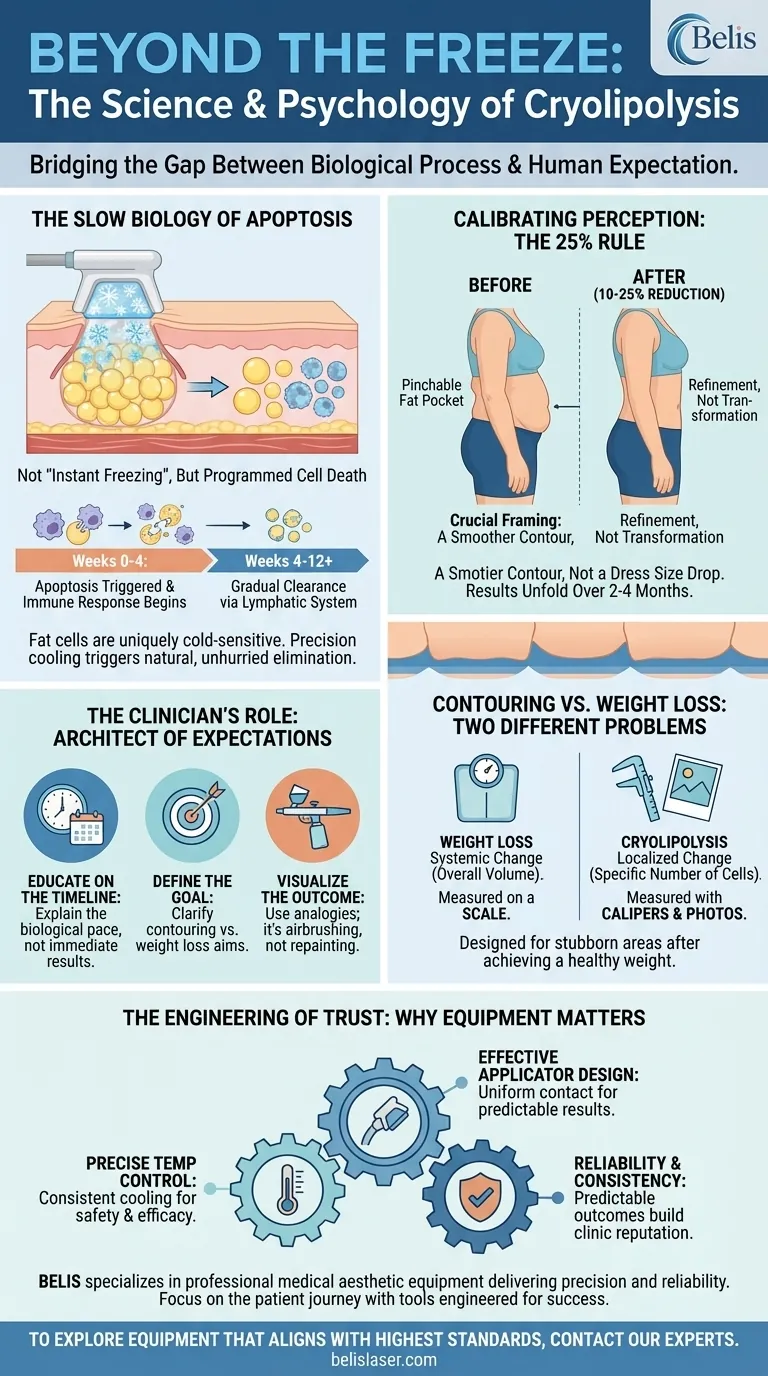
Cryolipolysis is often marketed as "fat freezing," a term that implies an instant, mechanical action. The reality is far more elegant and biological. The technology doesn't violently destroy fat cells; it initiates a quiet, natural cascade called apoptosis, or programmed cell death.
Fat cells (adipocytes) are uniquely sensitive to cold. A professional cryolipolysis device cools a targeted area to a precise temperature—cold enough to trigger apoptosis in fat cells but safe for the surrounding skin, nerves, and muscle. This precision is not a trivial detail; it is the cornerstone of the procedure's safety and effectiveness.
Once triggered, the process is handed over to the body's immune system. Over weeks and months, macrophages—the body's clean-up crew—gradually identify, engulf, and clear away the dead fat cells through the lymphatic system. It is a meticulous, unhurried process.
This is the engineer's romance of the treatment: it's a collaboration with the body's own systems, not an override.
Calibrating Perception: The 25% Rule
A single cryolipolysis session typically reduces fat cells in the treated area by 10% to 25%. This is a clinically significant number, but it's crucial to frame what it looks and feels like.
It is not a transformation. It is a refinement.
A 25% reduction in a small, pinchable bulge of fat doesn't translate to dropping a dress size. It translates to clothes fitting slightly better, a smoother contour, and a reduction in a stubborn spot that diet and exercise couldn't resolve. The result is a natural-looking improvement that unfolds over two to four months.
The Clinician's Role: Architect of Expectations
The most critical part of any cryolipolysis treatment happens in the consultation room, long before the machine is switched on. The practitioner's role is to be an architect of realistic expectations.
- Educate on the Timeline: Clearly explain that results are not immediate. Show a visual timeline of the biological process.
- Define the Goal: Is the goal weight loss or contouring? This is the most important distinction.
- Visualize the Outcome: Use analogies. It's like airbrushing a small imperfection, not repainting the entire canvas.
When patients understand the "why" behind the gradual timeline, they transition from waiting for a result to observing a process. Their perception shifts from impatience to appreciation.
Contouring vs. Weight Loss: Two Different Problems
The human mind often conflates fat reduction with weight loss. They are fundamentally different.
- Weight Loss is a systemic change, a decrease in the overall volume of fat cells throughout the body. It is measured on a scale.
- Cryolipolysis is a localized change, a decrease in the number of fat cells in a specific area. It is measured with calipers and photographs.
This procedure is designed for people who have already put in the work of achieving a healthy weight but are frustrated by genetic predispositions for storing fat in certain areas. It is the final, targeted step in their journey—not the first.
The Engineering of Trust: Why Equipment Matters
The biological process of apoptosis is precise. It demands equally precise technology. The trust a patient places in a clinic is an extension of the trust the clinic places in its equipment.
A professional-grade cryolipolysis machine delivers on three non-negotiable principles:
- Precise Temperature Control: The therapeutic window for triggering apoptosis without causing frostbite or other tissue damage is narrow. Consistent, controlled cooling is paramount for both safety and efficacy.
- Effective Applicator Design: The applicator must ensure full and consistent contact with the target area, creating a uniform cooling zone for predictable results.
- Reliability and Consistency: Delivering the same, precise cooling profile treatment after treatment builds a foundation of predictable outcomes, which in turn builds your clinic's reputation.
At BELIS, we specialize in professional medical aesthetic equipment that delivers on this promise of precision and reliability. Providing clinics with tools engineered for predictable results allows you to focus on what matters most: managing the patient's journey and delivering satisfaction.
Ultimately, cryolipolysis is an exceptional tool for body contouring. Its success lies in respecting its biological pace and deploying it for its intended purpose. By combining expert patient education with superior technology, you can close the expectation gap and consistently deliver results that both you and your clients can be proud of.
To explore equipment that aligns with the highest standards of safety and efficacy, Contact Our Experts.
Visual Guide
Related Products
- Cryolipolysis Fat Freezing Machine Ultrasonic Cavitation Fat Reducing Device
- Cryolipolysis Fat Freezing Machine and Ultrasonic Cavitation Device
- Cryolipolysis Fat Freezing Cavitation Lipo Laser Machine
- Cryolipolysis Fat Freezing Machine with Cavitation and Laser Lipolysis
- Cryolipolysis Fat Freezing Machine Cavitation Lipo Laser Machine
Related Articles
- From Crystal to Clearance: The Biological Journey of a Fat Cell After Cryolipolysis
- The Elegant Delay: Why Cryolipolysis Works on Biological Time, Not Human Time
- The Cryolipolysis Paradox: Why the First Week's Success is Invisible
- The Physics of Stubborn Fat: A Cold, Hard Look at Abdominal Contouring
- The -11°C Difference: Why Cryolipolysis Isn't Just Freezing Fat






