
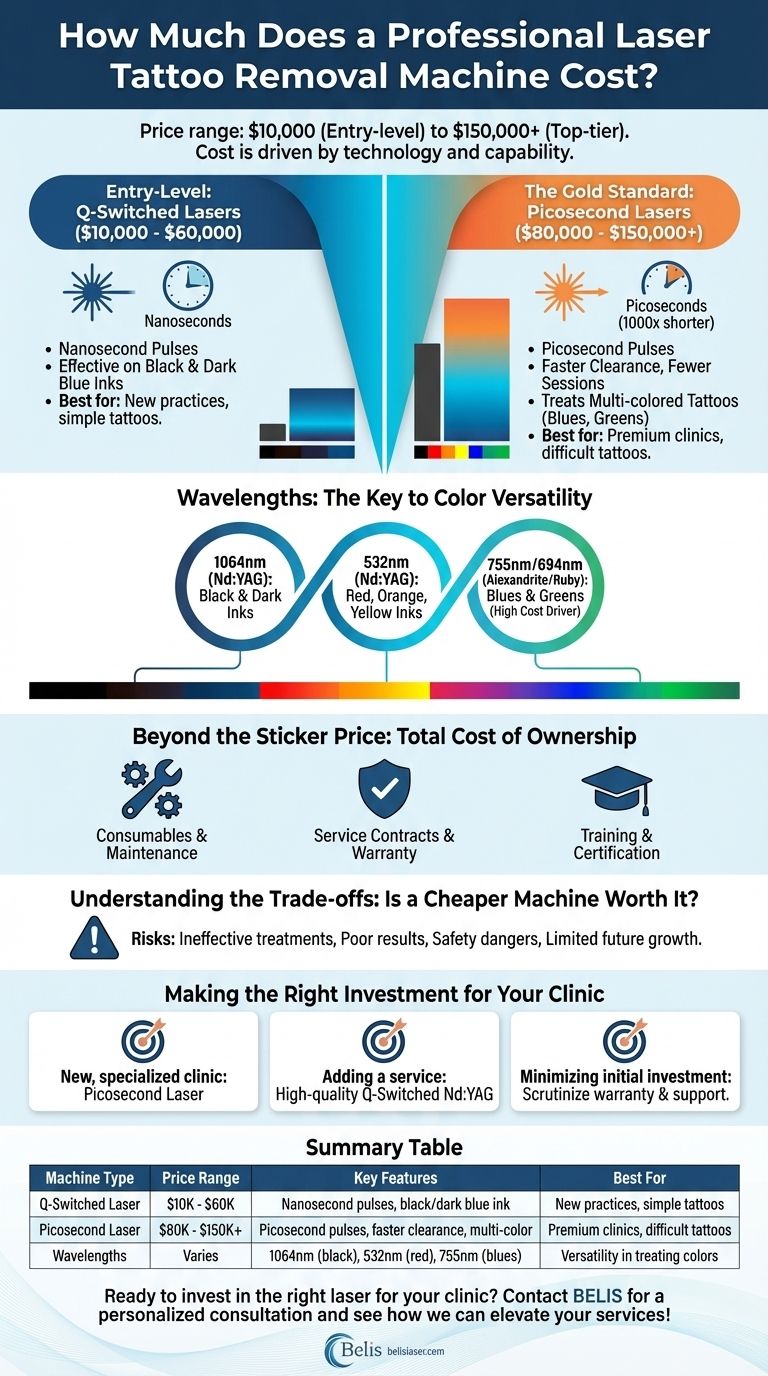
The price of a professional laser tattoo removal machine is not a single number, but a wide spectrum. You can expect to pay anywhere from $10,000 for a basic entry-level model to well over $100,000 for a top-tier, multi-wavelength system from a leading brand. This significant price difference is driven almost entirely by the sophistication of the laser technology within the device, which directly impacts its effectiveness and versatility.
The initial purchase price is only the beginning of the story. The true value and cost of a laser are determined by its underlying technology—Q-switched versus Picosecond—which dictates its clinical effectiveness, the range of colors it can treat, and its long-term operational costs.
What Drives the Cost? A Breakdown of Laser Technology
The core components of the laser—its pulse duration and the wavelengths it produces—are the primary factors that determine its price and, more importantly, its capability.
Entry-Level: Q-Switched Lasers ($10,000 - $60,000)
Q-switched (QS) lasers are the established workhorses of the industry. They operate by delivering powerful bursts of energy in nanoseconds.
These machines are highly effective on darker inks like black and dark blue. For a new practice or one focusing on simple, dark tattoos, a high-quality QS Nd:YAG laser is a reliable and profitable starting point.
The Gold Standard: Picosecond Lasers ($80,000 - $150,000+)
Picosecond lasers represent the cutting edge of tattoo removal technology. They deliver energy in picoseconds—a unit of time that is 1,000 times shorter than a nanosecond.
This ultra-short pulse shatters ink particles more effectively with less heat transfer to the surrounding skin. This often leads to faster clearance, fewer required treatment sessions, and superior results on difficult, multi-colored tattoos, especially vibrant blues and greens.
Wavelengths: The Key to Color Versatility
A laser's wavelength determines which color of ink it can "see" and treat. A machine with more wavelengths can treat a wider spectrum of tattoos, which significantly increases its utility and price.
- 1064nm (Nd:YAG): This is the most common wavelength and is standard on virtually all machines. It is the go-to for treating black and dark inks.
- 532nm (Nd:YAG): This wavelength is used for red, orange, and yellow inks. It is typically included with a 1064nm laser.
- 755nm (Alexandrite) or 694nm (Ruby): These specialized wavelengths are necessary for treating stubborn blues and greens. They are typically found only on premium Q-switched or Picosecond systems and are a major driver of higher costs.
Beyond the Sticker Price: Understanding Total Cost of Ownership
A smart investment requires looking beyond the initial purchase. The long-term operational costs are a critical part of the business equation.
Consumables and Maintenance
Lasers have parts that wear out. This can include flashlamps, optical filters, or disposable tips for the handpiece. Be sure to understand the expected lifespan of these components and their replacement cost.
Service Contracts and Warranty
A high-end medical device is a significant asset. A comprehensive warranty and an accessible service contract are not optional—they are insurance for your revenue stream. Inexpensive machines from unknown manufacturers often lack reliable support, which can lead to costly downtime.
Training and Certification
Operating a powerful laser safely and effectively requires expert training. Reputable manufacturers typically include comprehensive clinical training with the purchase. Factoring in the cost and quality of this training is essential for ensuring patient safety and achieving excellent results.
Understanding the Trade-offs: Is a Cheaper Machine Worth It?
While a lower initial price can be tempting, it often comes with significant hidden risks that can cost your business more in the long run.
The Risk of Ineffective Treatments
Lower-cost, underpowered machines may lack the energy or correct pulse duration to effectively clear a tattoo. This leads to an increased number of sessions, poor results, and dissatisfied clients who can damage your clinic's reputation.
The Danger of Poorly Made Devices
The primary concern with any aesthetic procedure is safety. Sub-standard machines from unvetted manufacturers carry a higher risk of causing adverse side effects like scarring, burns, or permanent skin pigmentation changes, creating a serious liability for your business.
Limited Capabilities and Future Growth
An entry-level machine that only treats black ink will limit your potential client base. Investing in a more versatile system from the start can allow your business to grow without needing to make another large capital purchase in the near future.
Making the Right Investment for Your Clinic
The right laser depends entirely on your business goals, your target clientele, and your budget.
- If your primary focus is starting a new, specialized clinic: Investing in a quality Picosecond laser allows you to market yourself as a premium service, effectively treat all colors, and build a strong reputation from day one.
- If your primary focus is adding a service to an existing practice: A high-quality Q-switched Nd:YAG laser is a reliable and profitable workhorse for treating the most common tattoos (dark inks).
- If your primary focus is minimizing initial investment: Scrutinize the warranty, service support, and included training on any entry-level device, as these factors often reveal the true long-term cost.
Choosing the right laser is a direct investment in your clinic's reputation, patient safety, and long-term profitability.
Summary Table:
| Machine Type | Price Range | Key Features | Best For |
|---|---|---|---|
| Q-Switched Laser | $10,000 - $60,000 | Nanosecond pulses, effective on black/dark blue ink | New practices, simple dark tattoos |
| Picosecond Laser | $80,000 - $150,000+ | Picosecond pulses, faster clearance, treats multi-colored tattoos | Premium clinics, difficult tattoos (blues, greens) |
| Wavelengths | Varies by machine | 1064nm (black), 532nm (red/orange), 755nm (blues/greens) | Versatility in treating different ink colors |
Ready to invest in the right laser tattoo removal machine for your clinic?
At BELIS, we specialize in professional medical aesthetic equipment for medical aesthetics clinics and premium beauty salons. Our experts will help you select a machine that matches your business goals, ensuring superior results, patient safety, and long-term profitability.
Contact us today for a personalized consultation and see how BELIS can elevate your services!
Visual Guide
Related Products
- Pico Laser Tattoo Removal Machine Picosure Picosecond Laser Machine
- Clinic Use IPL and SHR Hair Removal Machine with Nd Yag Laser Tattoo Removal
- Q Switch Nd Yag Laser Machine Tattoo Removal Nd Yag Machine
- Diode Laser SHR Trilaser Hair Removal Machine for Clinic Use
- Clinic Diode Laser Hair Removal Machine with SHR and Trilaser Technology
People Also Ask
- How does a laser tattoo removal machine work? Shattering Ink with Precision Light
- Why is the precise adjustment of energy density, or fluence, critical during picosecond laser tattoo removal procedures?
- How does the pulse duration of a laser system influence the efficacy of tattoo ink clearance? Master Picosecond Tech
- What role does picosecond laser equipment play in tattoo removal? Faster Results & Advanced Precision
- What are the technical advantages of Picosecond laser equipment? Achieve Superior Tattoo Removal & Faster Skin Healing















