
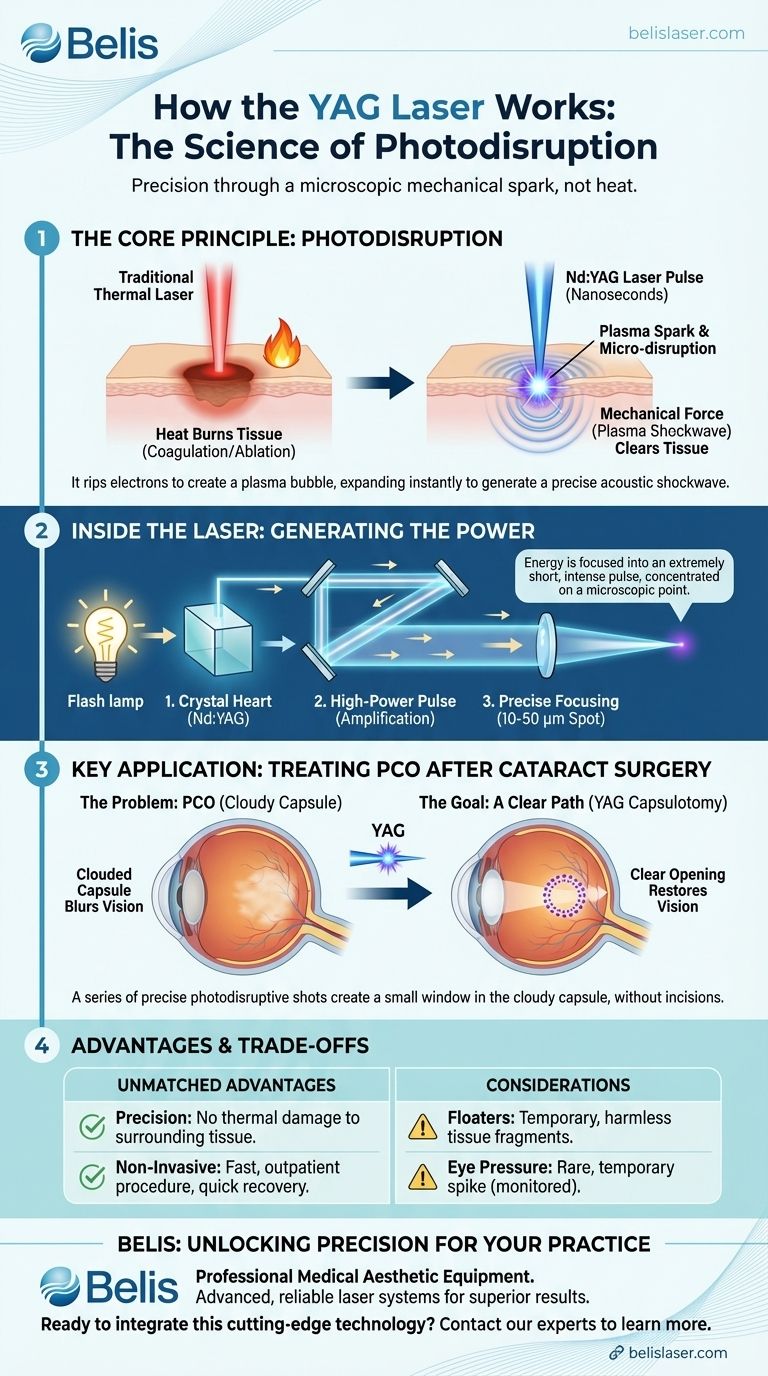
At its core, a YAG laser works by delivering an extremely short, high-energy pulse of light focused onto a microscopic point. This intense energy doesn't burn or cut tissue in the traditional sense; instead, it rips electrons from atoms to create a tiny spark of plasma. The rapid expansion of this plasma creates a micro-disruption, precisely clearing tissue at the focal point while leaving the surrounding areas completely untouched.
The critical insight is that the YAG laser is not a thermal tool that burns tissue. It is a mechanical tool that uses focused light to create a microscopic shockwave, a process called photodisruption, which provides unparalleled precision for delicate procedures like eye surgery.
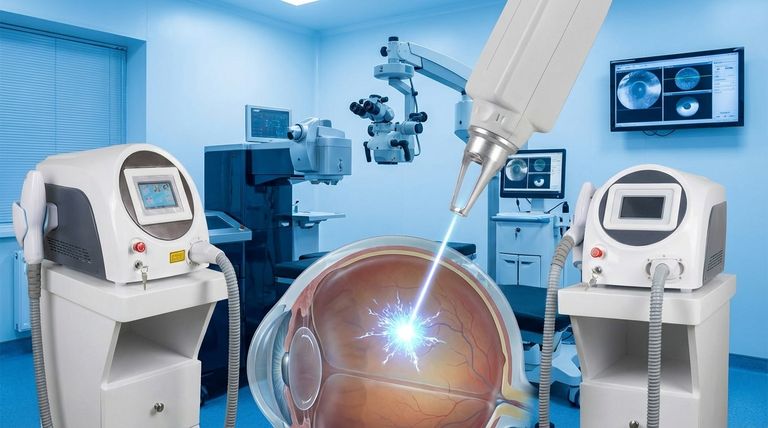
The Core Principle: Photodisruption, Not Heat
To truly understand how a YAG laser functions, it's essential to move past the idea of a cutting laser beam seen in movies. Its mechanism is far more sophisticated.
The Laser's Foundation: A Crystal Heart
The term "YAG" stands for Yttrium Aluminum Garnet, a synthetic crystal that serves as the heart of the laser.
This crystal is "doped" with another element, typically neodymium (Nd), which is why you will often see the laser referred to as an Nd:YAG laser. This crystal medium is what allows the laser to generate its specific wavelength of light.
Generating a High-Power Pulse
The process begins by "pumping" energy into the YAG crystal, typically with a flash lamp. This excites the neodymium atoms, which then release that energy as particles of light, or photons.
These photons are amplified within the laser cavity, emerging as a single, coherent, and very powerful pulse of infrared light. This pulse is extremely brief, lasting only a few nanoseconds.
The Power of Precise Focusing
The laser beam itself isn't what performs the work. The true magic lies in the optical system that focuses all of that pulse's energy down to a single, microscopic spot, typically around 10-50 micrometers in diameter.
This extreme concentration of energy is what enables the next, most critical step.
Creating a Microscopic Disruption
When this incredibly high concentration of energy hits its target, the intensity is so great that it strips electrons from the atoms in the tissue. This process, called optical breakdown, creates a small, superheated ball of ionized gas, or plasma.
This plasma bubble expands instantaneously, creating a tiny acoustic shockwave. It is this mechanical force—not heat—that tears or vaporizes the targeted tissue with incredible precision.
Application: Clearing Vision After Cataract Surgery
This mechanism is perfectly suited for its most common medical use: treating a condition that can occur after cataract surgery.
The Problem: Posterior Capsule Opacification (PCO)
During modern cataract surgery, the natural lens is removed, but the thin, clear membrane that held it—the posterior capsule—is left in place to support the new artificial lens implant.
In some patients, this capsule can become cloudy over time, causing blurry vision similar to the original cataract. This is known as Posterior Capsule Opacification (PCO).
The Goal: A Clear Path for Light
The goal of the YAG laser procedure (formally a YAG laser capsulotomy) is to create a small, clear opening in the center of this clouded capsule.
This allows light to once again pass unimpeded through the eye to the retina, restoring sharp vision.
The Procedure: A Series of Precise "Shots"
The ophthalmologist uses the YAG laser to deliver a series of these tiny photodisruptive pulses to the cloudy capsule.
Each pulse creates a microscopic hole. By carefully placing a pattern of these shots, the surgeon creates a clean, circular opening, effectively creating a new window for light to pass through.
Understanding the Trade-offs and Advantages
Like any medical technology, the YAG laser's design comes with a specific set of benefits and considerations.
Advantage: Unmatched Precision
The primary advantage is its non-thermal, mechanical nature. Because it isn't burning tissue, there is no thermal damage to surrounding structures. This is absolutely critical when working millimeters away from a delicate artificial lens implant and the retina.
Advantage: Non-Invasive and Fast
The procedure is performed without any incisions. It is a quick, painless outpatient treatment that typically takes only a few minutes, with vision often improving within hours.
Potential Side Effect: Floaters
The pieces of the disrupted capsule are released inside the eye and can initially be seen by the patient as "floaters." These are harmless and almost always resolve on their own over a few weeks.
Rare Complication: Increased Eye Pressure
In a very small number of cases, the procedure can cause a temporary spike in intraocular pressure. This is why your eye pressure is typically checked shortly after the procedure is completed.
How to Apply This Understanding
Your perspective on the YAG laser depends on your goal—whether you are a patient preparing for a procedure or a professional seeking to understand the technology.
- If you are a patient: Understand that the YAG laser is not "cutting" your eye with heat. It is using focused sound and force on a microscopic scale to safely clear away cloudy tissue, making it an exceptionally precise and low-risk procedure.
- If you are a technical professional: The key distinction is the mechanism of photodisruption. Differentiate this from other medical lasers that work by photocoagulation (using heat to seal tissue) or photoablation (using UV light to vaporize tissue layer by layer).
The YAG laser's ability to create a mechanical force from light represents a pinnacle of medical and engineering innovation.
Summary Table:
| Key Aspect | Description |
|---|---|
| Core Mechanism | Photodisruption (mechanical shockwave) |
| Laser Medium | Nd:YAG (Neodymium-doped Yttrium Aluminum Garnet) crystal |
| Primary Medical Use | Posterior Capsule Opacification (PCO) treatment after cataract surgery |
| Key Advantage | Unmatched precision with no thermal damage to surrounding tissue |
| Procedure Type | Non-invasive, fast, outpatient treatment |
Unlock the Power of Precision for Your Practice
Understanding the sophisticated technology behind the YAG laser is the first step. Equipping your clinic with the right technology is the next.
BELIS specializes in professional medical aesthetic equipment, providing advanced, reliable laser systems to medical aesthetics clinics and premium beauty salons. Enhance your service offerings and deliver superior, precise results to your clients.
Ready to integrate this cutting-edge technology? Let's discuss how our solutions can meet your specific needs.
Contact our experts today to learn more
Visual Guide
Related Products
- Q Switch Nd Yag Laser Machine Tattoo Removal Nd Yag Machine
- Clinic Use IPL and SHR Hair Removal Machine with Nd Yag Laser Tattoo Removal
- Clinic Use IPL SHR ND YAG Laser Hair Removal RF Skin Tightening Machine
- 9D 7D HIFU Vaginal RF Lifting Treatment
- Diode Tri Laser Hair Removal Machine for Clinic Use
People Also Ask
- What is the documented effectiveness of Q-switched Nd:YAG lasers for tattoo removal? Gold Standard Results
- How does laser fluence influence pigment clearance vs. safety? Balancing Speed and Skin Integrity in Tattoo Removal
- How are Q-switched lasers used for tattoo removal? Advanced Photoacoustic Technology for Clear Skin
- What are the additional functions of the Q-Switch ND:YAG laser system? Unlock Advanced Skin Rejuvenation and Firming
- Is Q Switched Nd:YAG laser good? The Gold Standard for Tattoo & Pigment Removal






