
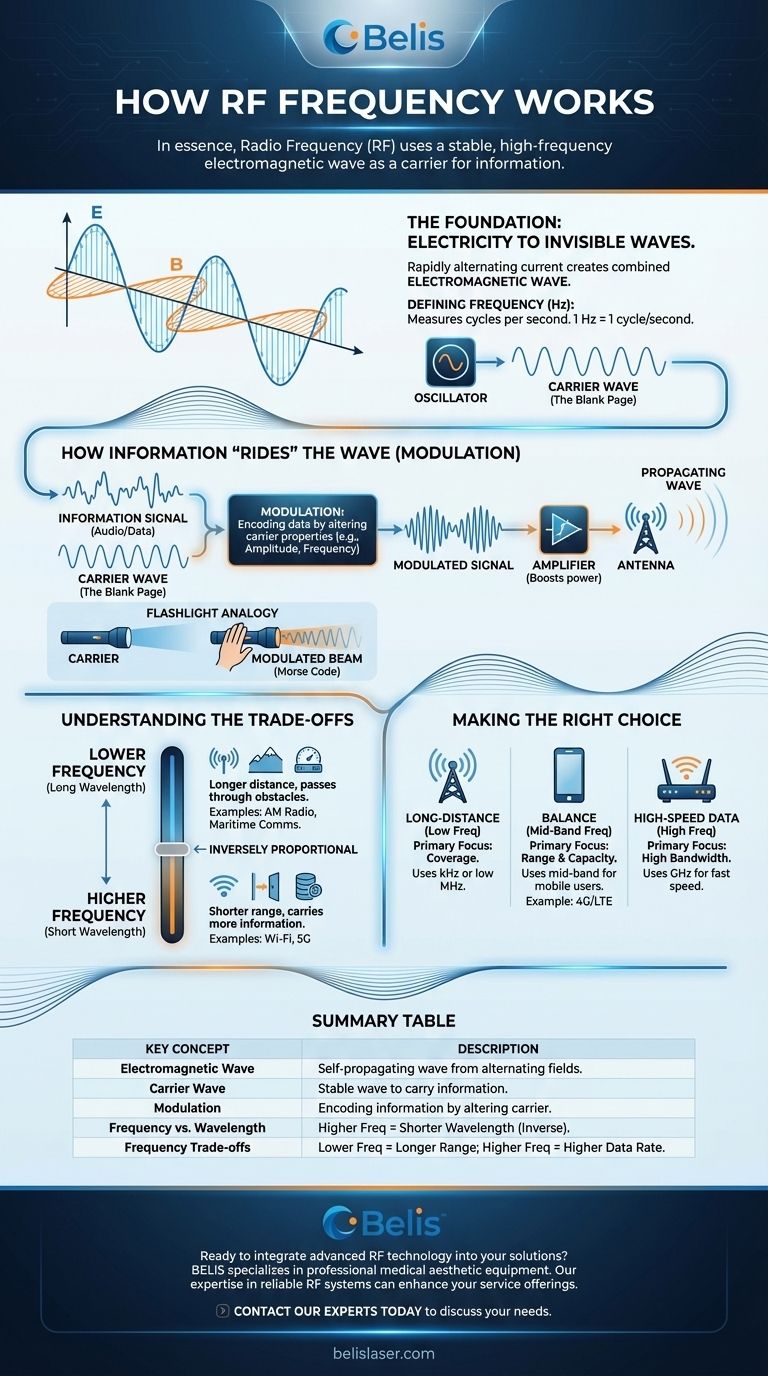
In essence, Radio Frequency (RF) works by using a stable, high-frequency electromagnetic wave as a carrier for information. An electronic circuit called an oscillator generates this carrier wave. The information you want to send—like audio or data—is then encoded onto this wave by systematically altering it in a process called modulation. This modulated signal is then amplified and converted by an antenna into an invisible wave that travels through the air to a receiver.
The core principle to understand is that RF isn't the information itself; it's the transportation system. RF technology provides a reliable, predictable wave (the "carrier") whose properties can be changed to represent and carry a lower-frequency information signal wirelessly over a distance.

The Foundation: From Electricity to Invisible Waves
To truly understand how RF works, we must start with the fundamental link between electricity and magnetism. This relationship is the engine that makes all wireless communication possible.
What is an Electromagnetic Wave?
A changing electric field creates a magnetic field. Likewise, a changing magnetic field creates an electric field.
When you have a rapidly alternating electric current, these two fields create each other back and forth, propagating outward from the source as a combined electromagnetic wave. This self-propagating wave is the "radio" in Radio Frequency.
Defining Frequency
Frequency is simply a measure of how many times the wave oscillates, or cycles, per second. This is measured in Hertz (Hz).
One cycle per second is 1 Hz. A radio station broadcasting at 98.7 FM is transmitting a carrier wave that oscillates 98,700,000 times per second (98.7 Megahertz or MHz).
Creating the Carrier Wave
The first step in any RF system is to create a stable, predictable wave. This is done by an oscillator, an electronic circuit designed to produce a continuous, repetitive alternating current at a very specific frequency.
This pure, un-altered wave is called the carrier wave. Think of it as a blank piece of paper, ready to have a message written on it.
How Information "Rides" the Wave
The carrier wave itself contains no useful information. The process of encoding your data onto that wave is called modulation, and it's the key to transmitting information.
The Concept of Modulation
Modulation is the act of systematically altering a property of the carrier wave—such as its amplitude (strength) or its frequency—in a pattern that mirrors the information signal you want to send.
The receiver is designed to detect these specific changes, ignore the stable carrier wave, and reconstruct the original information.
A Simple Analogy: The Flashlight
Imagine your carrier wave is the steady, unbroken beam of a powerful flashlight pointed at a friend across a field. The beam itself communicates nothing other than "I am on."
Now, imagine you use your hand to block the light in a specific pattern—the dots and dashes of Morse code. You have just modulated the beam's amplitude (its strength) to encode a message. Your friend can now decode that pattern to understand your message. This is the principle behind Amplitude Modulation (AM) radio.
From Signal to Transmission
Once the carrier wave is modulated, it's often too weak to travel a significant distance. An RF amplifier boosts the power of the modulated signal.
Finally, this high-power electrical signal is fed to an antenna. The antenna's job is to efficiently convert the electrical energy of the signal into a propagating electromagnetic wave that radiates out into space.
Understanding the Trade-offs
The specific frequency chosen for a task is not arbitrary. It involves fundamental trade-offs that dictate how the signal behaves and what it can be used for.
Frequency and Wavelength
Frequency is inversely proportional to wavelength. A higher frequency means a shorter wavelength, and a lower frequency means a longer wavelength.
This physical difference has massive implications for how the wave travels and interacts with the environment.
Impact on Range and Penetration
Lower frequencies (longer wavelengths), like those used for AM radio, can travel very long distances and pass through obstacles like buildings and hills with relative ease.
Higher frequencies (shorter wavelengths), like those used for Wi-Fi and 5G, have a much shorter range and are easily blocked by walls, trees, and even rain.
Impact on Data Rate
The major advantage of higher frequencies is their ability to carry more information. A higher frequency wave oscillates more times per second, providing more opportunities to modulate the signal and thus encode more data within the same amount of time.
This is why your 5 GHz Wi-Fi band is typically faster than the 2.4 GHz band, but it also has a shorter effective range.
Making the Right Choice for Your Goal
Understanding these principles allows you to see why different technologies use specific frequency bands.
- If your primary focus is long-distance coverage (like broadcast radio or maritime communication): You will use lower frequencies (in the kHz or low MHz range) that can travel for hundreds of miles.
- If your primary focus is high-speed data (like 5G or Wi-Fi): You will use much higher frequencies (in the GHz range) to achieve high bandwidth, accepting the trade-off of shorter range and the need for more towers or access points.
- If your primary focus is a balance of range and capacity (like 4G/LTE cellular): You will use mid-band frequencies that offer a practical compromise between coverage and data speed for mobile users.
By selecting a frequency, engineers are fundamentally choosing the right vehicle for the specific information-delivery job at hand.
Summary Table:
| Key Concept | Description |
|---|---|
| Electromagnetic Wave | Self-propagating wave created by alternating electric and magnetic fields. |
| Carrier Wave | Stable, high-frequency wave generated by an oscillator to carry information. |
| Modulation | The process of encoding information onto a carrier wave by altering its properties. |
| Frequency vs. Wavelength | Higher frequency = shorter wavelength; Lower frequency = longer wavelength. |
| Frequency Trade-offs | Lower frequencies = longer range; Higher frequencies = higher data rates. |
Ready to integrate advanced RF technology into your solutions?
BELIS specializes in professional medical aesthetic equipment, serving medical aesthetics clinics and premium beauty salons. Our expertise in reliable, high-performance RF systems can help you deliver superior treatments to your clients.
Contact our experts today to discuss how our RF-based solutions can enhance your service offerings and drive your business growth.
Visual Guide
Related Products
- Multifunctional Laser Hair Growth Machine Device for Hair Growth
- RF Microneedling Machine Micro Needle Radio Frequency Machine
- EMSlim RG Laser Body Sculpting and Slimming Machine
- RF Microneedling Machine Micro Needle Radio Frequency Machine
- Multifunctional Laser Hair Growth Machine Device for Hair Growth
People Also Ask
- Why do professional-grade laser hair growth devices integrate LCD displays? Achieve Clinical Precision in Every Session
- What is a typical treatment schedule when using a laser hair growth device? Maximize Results with the Proven Protocol
- How do professional-grade laser stimulation devices contribute to improving hairline morphology? Revitalize Growth & Symmetry
- For which conditions have laser hair growth treatment devices been approved? Targeted Solutions for Androgenic Alopecia
- How do the biological phases of the hair growth cycle inform the clinical application of specialized hair growth devices for treating androgenetic alopecia? Insights for Clinics & Salons















