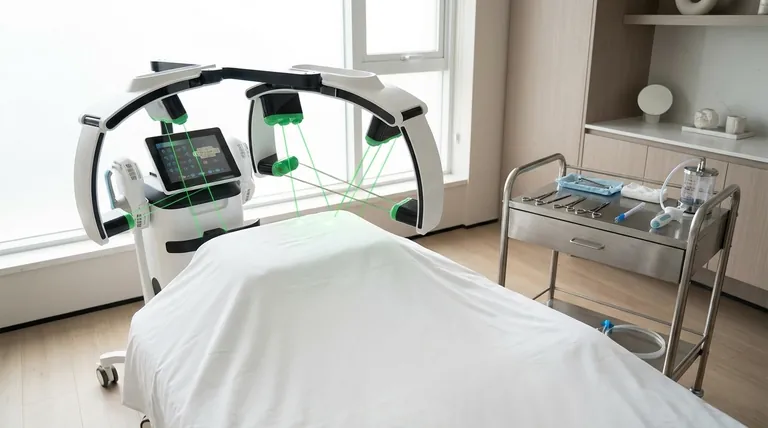
The Illusion of a "Better" Choice
In medicine, as in engineering, we often crave a simple answer to the question: "Which one is better?"
Our minds are wired to seek clear winners and losers, to put new technology against the old. But this binary thinking often misses the point. The most advanced tools aren't necessarily "better"; they are designed for a more specific purpose.
This is the case with liposuction. The debate between laser and traditional methods isn't about which is superior. It’s about understanding two distinct engineering approaches to solving two different problems. The right question isn't "which is better?" but "what is the job we need to do?"
Two Philosophies of Subtraction
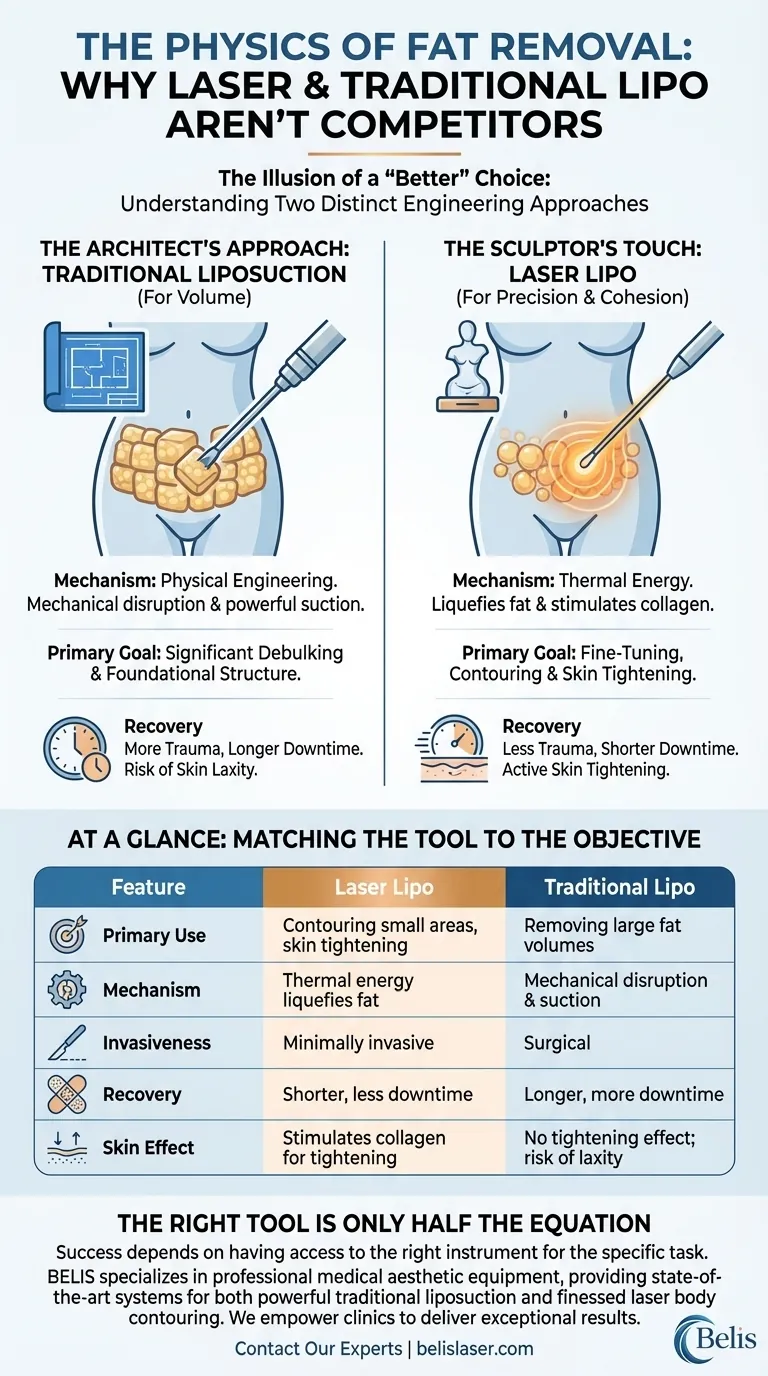
At their core, both procedures remove fat. But they operate on entirely different principles, reflecting two philosophies of body contouring. One is about architecture; the other is about sculpture.
The Architect's Approach: Traditional Liposuction for Volume
Traditional liposuction is an act of physical engineering. It is a surgical procedure where a surgeon uses a cannula to mechanically break apart and suction out fat deposits.
Its genius lies in its directness and power.
For clients whose primary goal is significant debulking—removing large volumes of fat from areas like the abdomen or thighs—this method remains the gold standard. It is the tool for making substantial changes to the body's foundational structure.
The Sculptor's Touch: Laser Lipo for Precision and Cohesion
Laser liposuction works with more finesse. A tiny cannula housing a laser fiber is inserted, and its energy liquefies fat cells before they are gently removed. This process is inherently less traumatic to the surrounding tissue.
But its true innovation lies in a secondary effect.
The laser's thermal energy heats the underlying dermis, triggering a biological cascade that stimulates new collagen production. This is the crucial difference: it doesn't just subtract fat; it actively encourages the skin to tighten and remodel over the new contour. It's a tool for refining details and ensuring the final form is smooth and cohesive.
The Human Equation: Recovery and Final Form
The choice of technology has profound implications for the human experience—from the recovery process to the final aesthetic outcome. The trade-offs are not just technical; they are deeply personal.
The Trade-off Between Power and Peace
The power of traditional liposuction comes at a cost: greater tissue trauma. This translates into more significant post-procedural bruising, swelling, and a longer, more uncomfortable recovery period.
Laser liposuction, being minimally invasive, offers a gentler path. By melting fat instead of physically breaking it apart, it minimizes trauma. Patients experience less downtime and can often return to their lives much faster. This isn't just a convenience; it's a fundamental factor in the overall patient journey.
The Unseen Problem: Skin After Fat Loss
One of the biggest challenges in body contouring is what happens to the skin after fat is removed. With traditional liposuction, especially in patients with poor skin elasticity, removing a large volume can leave behind a void, resulting in skin laxity or sagging.
Laser liposuction elegantly preempts this problem. The collagen stimulation it provides is not just a "bonus feature"—it's an integrated solution to the problem of skin laxity. The skin-tightening effect continues to improve for months, ensuring the final result looks natural and firm.
A Framework for Choosing the Right Tool
The "better" procedure is simply the one that correctly aligns with the patient's anatomy, goals, and lifestyle priorities. Making the right recommendation requires a clear-eyed assessment of the objective.
At a Glance: Matching the Tool to the Objective
| Feature | Laser Lipo | Traditional Lipo |
|---|---|---|
| Primary Use | Contouring small areas, skin tightening | Removing large fat volumes |
| Mechanism | Thermal energy liquefies fat | Mechanical disruption & suction |
| Invasiveness | Minimally invasive | Surgical |
| Recovery | Shorter, less downtime & bruising | Longer, more downtime & swelling |
| Skin Effect | Stimulates collagen for skin tightening | No tightening effect; risk of laxity |
| Best For | Fine-tuning, contouring, stubborn fat | Significant, large-scale fat reduction |
The Right Tool Is Only Half the Equation
Ultimately, a surgeon's success depends on having access to the right instrument for the specific task at hand. Offering only one solution limits the ability to provide truly customized, optimal outcomes. The best clinics aren't dogmatic; they are equipped.
BELIS specializes in professional medical aesthetic equipment, providing state-of-the-art systems for both powerful traditional liposuction and finessed laser body contouring. We empower clinics and salons to deliver exceptional results by ensuring they have the highest quality tools to match their expertise—whether the job calls for an architect's vision or a sculptor's touch.
To ensure your practice is equipped to meet every client's unique needs with the best possible technology, Contact Our Experts.
Visual Guide
Related Products
- Cryolipolysis Fat Freezing Machine Cavitation Lipo Laser Machine
- Cryolipolysis Fat Freezing Cavitation Lipo Laser Machine
- Cryolipolysis Fat Freezing Machine with Cavitation and Laser Lipolysis
- EMSlim RG Laser Body Sculpting and Slimming Machine
- Cryolipolysis Fat Freezing Machine and Ultrasonic Cavitation Device
Related Articles
- From Crystal to Clearance: The Biological Journey of a Fat Cell After Cryolipolysis
- Beyond the Freeze: The Science and Psychology of Cryolipolysis
- The Elegant Delay: Why Cryolipolysis Works on Biological Time, Not Human Time
- The -11°C Difference: Why Cryolipolysis Isn't Just Freezing Fat
- The Physics of Stubborn Fat: A Cold, Hard Look at Abdominal Contouring


















